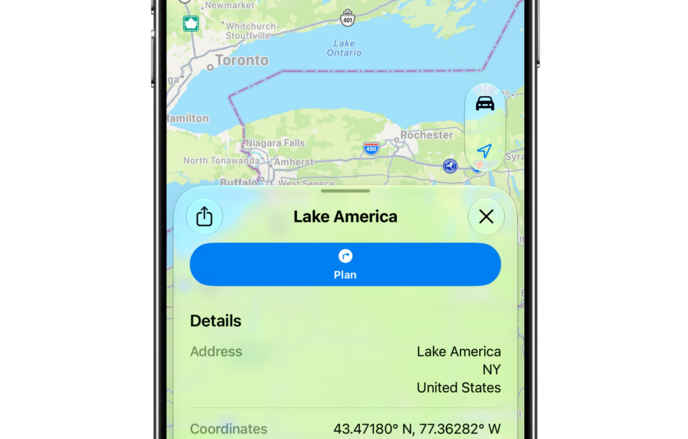
Apple has changed the name of Lake Ontario to “Lake America” on Apple Maps, but only for people browsing from the United States. The update rolled out on Tuesday, September 1, 2026. It follows a similar change that Google made to Google Maps just days earlier.
The switch affects the web version of Apple Maps first, with the change expected to spread across iPhone, iPad, and Mac apps shortly after. Users in Canada will continue to see “Lake Ontario” as before. People browsing from outside North America will see both names listed together.
Background: Trump’s Executive Order on Lake Ontario
The name change traces back to an executive order signed last week by US President Donald Trump. The order directed federal agencies to rename Lake Ontario as “Lake America” within official US government records.
This move echoes an earlier decision by the Trump administration to rename the Gulf of Mexico as the “Gulf of America.” That change was also picked up by Apple and Google Maps earlier this year, setting a clear precedent for how tech companies respond to these federal naming orders.
Once the executive order was signed, the US Geographic Names Information System (GNIS) updated its official database. Mapping companies like Apple and Google generally follow GNIS listings for how they label places inside the United States.
How the Change Rolled Out
Google was first to act, updating Google Maps for US users late last Saturday. That update briefly caused confusion in Canada, where some government and business websites embedding Google Maps briefly displayed “Lake America” instead of “Lake Ontario.”
Apple held off for a few days before making its own update. According to reports, President Trump personally contacted Apple to request the change directly, separate from the standard GNIS update process.
By Tuesday afternoon, tapping on the lake within Apple Maps displayed the new “Lake America” label, even before the main map text had fully updated. Apple confirmed the change applies only to its US-based users, keeping the original name intact for Canadian users and showing both names internationally.
Quotes From Officials
US Interior Secretary Doug Burgum addressed the topic during an interview on Fox Business. He said the president had reached out to Apple directly to encourage the update, adding that he expected Apple’s maps to reflect “Lake America” soon after.
Burgum also explained the process behind the change, noting that a presidential executive order requires the Department of the Interior’s Board of Geographic Names to update its records, which then affects every major map provider relying on that database.
Not every company followed suit. MapQuest publicly declined to rename the lake on its platform. Instead, it built a tool letting users assign the lake any name they choose, a move that drew attention on social media and reportedly boosted the app’s download numbers.
Impact of the Name Change
The renaming touches millions of daily map users across the US and Canada, given that Lake Ontario is one of the five Great Lakes and sits directly on the international border. Confusion has already surfaced in Canada, where some organizations that rely on embedded Google Maps briefly displayed the new US-only label by mistake.
The decision also lands in the middle of an ongoing trade dispute between the United States and Canada. Trump linked the renaming to broader tensions over tariffs, framing it as part of a wider disagreement with Canada. Critics argue that changing the name of a shared natural landmark adds an unnecessary layer of friction to that relationship.
For businesses and government bodies that embed Apple or Google Maps on their own websites, the update could require monitoring to ensure the correct regional name displays for their audience.
Conclusion
Apple’s decision to rename Lake Ontario to “Lake America” for US users marks another case of a major tech company aligning its mapping products with a presidential executive order, following the same pattern set by the Gulf of Mexico renaming earlier this year. Canadian users will continue to see “Lake Ontario,” while the rest of the world will see both names side by side.
Whether other mapping platforms such as Microsoft’s Bing Maps will follow remains to be seen. For now, the change is another example of how geopolitical decisions are increasingly shaping the digital tools people use every day.
Frequently Asked Questions
Was Lake Ontario actually renamed?
Yes, within the United States. President Trump signed an executive order directing the renaming of Lake Ontario to “Lake America” in official US government geographic records. The US Geographic Names Information System updated its database to reflect this change, and major mapping companies including Google and Apple then updated their US-facing apps to match. Outside the US, the lake’s original name remains unchanged, and Canada continues to officially refer to it as Lake Ontario.
Why is Google changing the name of Lake Ontario?
Google explained that it updates Google Maps to match official government naming sources, and for locations inside the United States, that source is the Geographic Names Information System. Once GNIS updated its records to show “Lake America” following the executive order, Google Maps automatically reflected that name for its US-based users. Google noted this follows its long-standing policy for bodies of water that carry different names in different countries, showing the local name to local users and both names elsewhere.
What has Trump renamed?
Lake Ontario is the most recent example, but it isn’t the first body of water affected by this kind of executive order. Earlier in his term, Trump signed a similar order renaming the Gulf of Mexico as the “Gulf of America,” a change that was also adopted by Apple Maps and Google Maps for US users. Both cases involve renaming shared international bodies of water solely within US government records and US-facing map applications.