

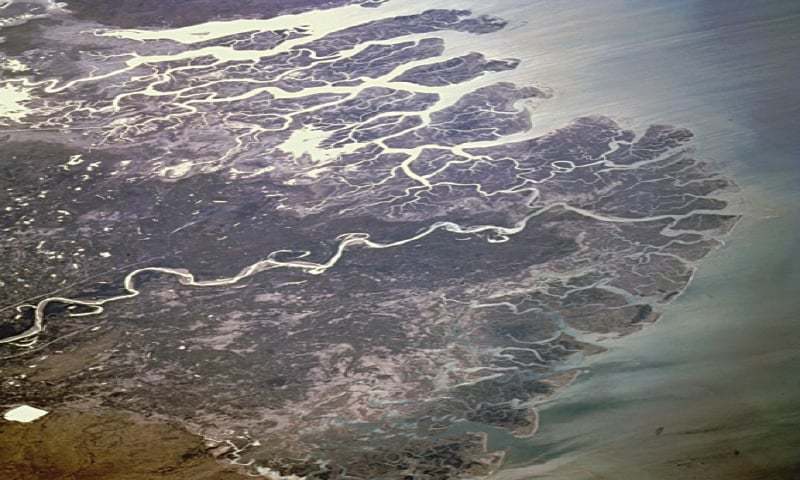

A Region on the Edge of Disappearing
The Indus Delta in Pakistan is running out of time. Once a rich, green stretch of rivers, creeks and farmland, it is now drying up, eroding away and sinking under the weight of an advancing sea. Freshwater and sediment that used to flow down from the Indus River barely reach the coast anymore, and the effect on the people who live there has been devastating.
Families in Thatta, Sujawal and Keti Bandar are watching their homes, fields and fishing grounds disappear. Many have already packed up and left. Those who remain are struggling to survive on land that grows saltier every year.
Where Is the Indus Delta Located?
People often ask, “where is Indus Delta located?” The answer lies along the southern coast of Sindh province, at the point where the Indus River finally meets the Arabian Sea. It stretches across the districts of Thatta, Sujawal and Badin, covering a coastline of roughly 250 kilometres.
This makes the Indus Delta in Pakistan one of the largest arid-climate deltas anywhere on Earth. It sits close to Karachi, the country’s biggest city, which means the fate of the delta is closely tied to the future of one of Pakistan’s most important economic hubs.
Background: How the Delta Reached This Point
The Indus Delta was never meant to run dry. For centuries, the river carried huge amounts of freshwater and silt down to the coast, feeding forests, farmland and fisheries along the way. That balance began to break down once large dams and barrages were built further upstream.
Structures such as Tarbela, Mangla and Chashma now hold back a significant share of the river’s flow before it can reach the sea. As a result, the amount of freshwater and sediment reaching the lower delta has fallen sharply over the decades, leaving the coast defenceless against the advancing Arabian Sea.
Older residents of Keti Bandar still remember when the town was a busy trading port. Today it is a shadow of what it once was, with most of its original population gone.
Details: What Is Happening on the Ground Today
Coastal erosion and seawater intrusion have already swallowed large amounts of farmland across Thatta and Sujawal districts. Villages that once grew rice, wheat and vegetables now sit on land too salty to farm. Groundwater, the only backup source many families had, has also turned brackish in large parts of the coast.
The delta of the Indus River is called a dying delta by researchers and journalists alike, and the description fits. Wetlands are shrinking, agricultural land is vanishing, and entire settlements have been abandoned as the sea keeps pushing inland.
Indus Delta Mangroves Under Pressure
The Indus Delta mangroves once covered a vast area along the coast, protecting villages from storms and supporting fish, shrimp and crab populations that local communities depended on for their livelihood. These mangrove forests have shrunk dramatically as freshwater flow has declined, since mangroves need a mix of fresh and salt water to survive.
With less freshwater reaching the coast, salinity levels have risen well beyond what many mangrove patches can tolerate. Fishing communities say their catch has dropped year after year, forcing younger family members to look for work in Karachi instead of staying on to fish.
Quotes: What Officials and Experts Are Saying
Local researchers and community leaders have been vocal about the scale of the crisis. Coastal experts point out that land equal to millions of acres has already been lost to the sea across Thatta and Sujawal, affecting well over a hundred settlements in the two districts.
Deputy administrative officials in Thatta have acknowledged that although the pace of new sea intrusion has slowed in certain pockets in recent years, residents continue to point out land they once owned that now lies underwater. Fisherfolk representatives estimate that more than a million people have already migrated from the delta districts to Karachi in search of work and safer housing.
Impact: A Regional and National Crisis
The shrinking of the Indus Delta in Pakistan is not just a local issue confined to a few coastal villages. It carries consequences for the whole province and, in some ways, for the country as a whole.
- Livelihoods lost: Farming and fishing communities that depended on the delta for generations have lost their main source of income.
- Mass migration: Large numbers of families have moved to Karachi and other cities, adding pressure to already stretched urban infrastructure.
- Food and water security: Farmland turning saline reduces the amount of arable land available for crops in Sindh.
- Biodiversity loss: Shrinking Indus Delta mangroves threaten fish nurseries, migratory birds and marine life along the coast.
- National debate on water sharing: The delta’s decline has also fed into wider arguments over how the Indus River’s water should be distributed between provinces and used upstream.
Conclusion: Can the Indus Delta Be Saved?
Experts generally agree on what the delta needs most: a steady, guaranteed flow of freshwater and sediment reaching its lower reaches, along with active efforts to restore its mangrove forests. Programs to replant mangroves along the Sindh coast have shown some success in smaller pockets, but they have not been enough to offset the wider retreat of the delta.
Without a sustained increase in downstream water flow, the outlook for the region remains difficult. Government agencies, environmental groups and international partners continue to discuss coastal resilience projects for Sindh, but progress on the ground has been slow compared to the speed at which the sea keeps advancing.
For now, the story of the Indus Delta in Pakistan remains one of loss — of land, of livelihoods and of a way of life that stretches back generations. What happens next will depend on decisions made far upstream, long before the river ever reaches the sea.
Frequently Asked Questions
What is meant by Indus Delta?
The Indus Delta refers to the vast area of land, creeks, wetlands and mangrove forests formed where the Indus River splits into many channels before draining into the Arabian Sea, along the coast of Sindh province in Pakistan. It spans the districts of Thatta, Sujawal and Badin and was historically one of the largest deltas in Asia, supporting farming, fishing and a rich variety of wildlife. Today, when people ask what the delta of the Indus River is called, the short answer is simply “the Indus Delta,” though many now refer to it as a dying or shrinking delta because of how fast it is losing land to the sea.
Why is Indus Delta called Dying delta and how can it be conserved?
The Indus Delta is often called a dying delta because it no longer receives enough freshwater and sediment from upstream to hold back the Arabian Sea. Dams and barrages built further up the Indus River have reduced the natural flow reaching the coast, allowing saltwater to intrude into farmland, groundwater and mangrove forests across Thatta, Sujawal and Badin. This has led to widespread land loss, falling fish catches and large-scale migration toward Karachi. Conservation efforts that could help include releasing a guaranteed minimum flow of freshwater down to the delta, large-scale mangrove replanting programs, better management of groundwater extraction, and stronger coastal protection infrastructure for the most exposed villages.
Can China stop Indus River?
The Indus River originates in the Tibet Autonomous Region of China, near Lake Mansarovar, so China does control a small portion of its upper course. Reports indicate China has built limited hydro infrastructure near the river’s source in that area. However, only a small share of the Indus’s total water volume actually comes from the Tibetan stretch, since the bulk of the river’s flow builds up later from tributaries and glacial melt within Pakistan-administered and Indian-administered territory. This means that while China has some technical ability to affect the uppermost flow of the river, it does not have the capacity to “stop” the Indus River as a whole or single-handedly control the water reaching Pakistan’s plains and its delta.