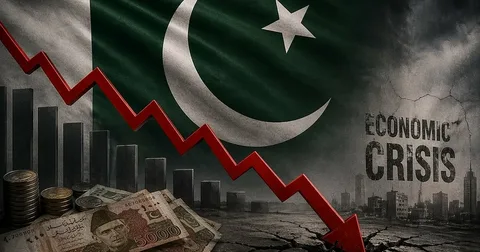
Pakistan’s cash economy has expanded to a record level even as poverty in Pakistan has climbed to its highest point in more than a decade. New State Bank data shows currency in circulation crossing Rs11.94 trillion in fiscal year 2025-26, while government survey figures put the national poverty rate at nearly 29 percent. Together, these two trends paint a troubling picture of an economy that remains heavily undocumented and increasingly unequal, despite years of digital banking investment and reform promises.
Background
For more than a decade, Pakistan’s policymakers have promoted digital banking as the long-term fix for the country’s dependence on paper currency. The cash economy in Pakistan has instead grown larger, not smaller, even as mobile wallets, QR merchants and instant payment systems have multiplied across major cities. At the same time, poverty in Pakistan has followed its own troubling trajectory. After declining steadily between 2005 and 2019, the national poverty rate reversed course sharply during the economic turmoil of the past several years, driven by inflation, currency depreciation, floods and stagnant real incomes. These two stories are closely linked. A large cash economy in Pakistan means fewer transactions are recorded, fewer businesses pay documented taxes, and fewer households build the financial histories needed to access credit, insurance or formal savings. That, in turn, makes it harder for lower-income families to escape poverty in Pakistan when shocks like floods or inflation hit.
Details
According to newly reported figures, currency in circulation in Pakistan reached Rs11.94 trillion during fiscal year 2025-26, marking a 94 percent jump from Rs6.14 trillion just five years earlier in FY2020. This growth in the cash economy in Pakistan occurred during the same period that mobile banking transaction value expanded dramatically and the number of active digital merchants roughly quadrupled nationwide. The average cash withdrawal per bank branch also tells a striking story. It rose from around Rs124,500 in FY2020 to close to Rs275,000 in FY2025, growing far faster than inflation. Meanwhile, deposit transactions per 100 withdrawals fell from nearly sixteen to fewer than nine over the same five years, showing that money is increasingly pulled out of the formal banking system rather than kept within it. Industry reports have separately estimated that Pakistan’s undocumented economy, closely tied to its cash economy, equals roughly 40 percent of national GDP. Pakistan’s cash-in-circulation ratio stands at around 34 percent of the money supply, compared with 16 percent in Bangladesh, 15 percent in India and just 9 percent in Kenya, underscoring how far Pakistan lags regional peers on financial digitisation. On the poverty side, official survey data released earlier this year showed poverty in Pakistan climbing to 28.9 percent, the highest level in eleven years. Roughly 70 million people are now estimated to live below the monthly poverty line of Rs8,484, a threshold meant to cover only the most basic household needs. That represents a 32 percent increase in poverty in Pakistan since the last full household survey was conducted in 2018-19, when the rate stood at 21.9 percent. The divide between rural and urban poverty in Pakistan remains stark. Rural poverty was measured at 36.2 percent, more than double the urban rate of 17.4 percent, reflecting long-standing disparities in access to jobs, healthcare, education and formal financial services across the country. Separately, under revised World Bank income thresholds, Pakistan’s poverty headcount was recalculated at 44.7 percent, based on a new international poverty line of $4.20 per person per day. Extreme poverty in Pakistan under these updated criteria was found to have jumped to 16.5 percent from an earlier estimate of 4.9 percent, though economists caution that some of this data still relies on outdated household surveys.
Quotes
Officials tracking Pakistan’s economy say the pattern is one of parallel systems rather than a true transition away from cash. As one senior banking sector analysis put it, Pakistan is digitising the movement of money far faster than it is digitising how that money is finally spent, leaving cash firmly embedded at the point of every real transaction. Economic researchers monitoring poverty in Pakistan have also flagged the disconnect between headline growth figures and everyday living standards. According to commentary from AHL’s Head of Research, Pakistan’s recent poverty numbers show that while macroeconomic conditions have stabilised somewhat, the benefits of that recovery have not reached ordinary households evenly, particularly in rural areas. World Bank poverty specialists have similarly noted that the revised international poverty line reflects updated global price data, and that Pakistan’s true poverty situation may still be underestimated given how old the underlying household survey data has become.
Impact
The scale of Pakistan’s cash economy carries consequences well beyond convenience at the till. A large, undocumented cash economy in Pakistan narrows the government’s tax base, forcing heavier reliance on indirect taxes that fall disproportionately on lower-income households already struggling with poverty in Pakistan. It also weakens financial inclusion. Households and small businesses operating mostly in cash rarely build the credit history needed to access formal loans, insurance, or long-term savings products, keeping them locked out of tools that could help cushion against inflation, floods or job losses. On the poverty side, rising food, energy and transport costs accumulated over recent years continue to strain household budgets even as headline inflation has eased from crisis-era peaks. Multidimensional poverty measures, which look beyond income alone, show that nearly 38 percent of Pakistan’s population faces overlapping deprivations in education, healthcare, housing and digital access, with another 13 percent considered vulnerable to falling into poverty in the near future. For international lenders and investors, both trends matter. A shrinking formal economy and elevated poverty in Pakistan complicate long-term IMF programme targets, reduce fiscal space for social protection spending, and slow the pace at which growth translates into improved living standards for ordinary citizens.
Conclusion
Analysts expect Pakistan’s cash economy to remain resistant to digitisation in the near term, even as instant payment systems like Raast continue to expand in scale. Meaningful change will likely require government payrolls, large retail chains and property transactions to shift decisively toward digital rails, rather than digital adoption at the margins. On poverty, World Bank projections suggest only a gradual improvement is likely, with poverty in Pakistan expected to ease modestly toward the low 20s percent range over the next couple of fiscal years, assuming macroeconomic stability holds and no major new shocks emerge. Sustained progress will depend heavily on how effectively growth is translated into real wage gains, expanded social protection coverage, and deeper financial inclusion for the millions of Pakistani households still operating largely outside the formal economy.
FAQs
Is Pakistan a 1 trillion economy?
No, Pakistan’s economy is not currently valued at 1 trillion dollars. Pakistan’s nominal GDP is estimated at several hundred billion dollars, placing it well below the trillion-dollar mark reached by much larger economies. However, when measured using purchasing power parity, which accounts for domestic price levels rather than exchange rates, Pakistan’s economy appears significantly larger and ranks among the bigger economies in the world by that alternative measure. The scale of Pakistan’s undocumented cash economy also means official GDP figures likely understate the true size of economic activity happening outside formal, recorded channels.
What does “cash economy” mean?
A cash economy refers to a system where a large share of transactions are conducted using physical currency rather than digital payments, bank transfers, or card-based systems. In Pakistan’s case, this means salaries, business payments, property deals and everyday purchases are frequently settled in paper currency even when digital alternatives exist. A large cash economy in Pakistan makes it harder for regulators to track transactions, collect taxes efficiently, and integrate informal businesses and workers into the formal financial system, which in turn limits access to credit and formal financial protections for millions of people.
Did Pakistan hit 400 billion GDP?
Pakistan’s nominal GDP has fluctuated around the 300 to 400 billion dollar range in recent years, depending on exchange rate movements and the specific fiscal year being measured, since currency depreciation directly affects dollar-denominated GDP figures. Given the size of Pakistan’s informal and cash-based economy, many economists argue that official GDP figures likely undercount real economic activity, meaning the true size of the economy could be somewhat larger than headline government statistics suggest once informal sector activity is more fully captured.