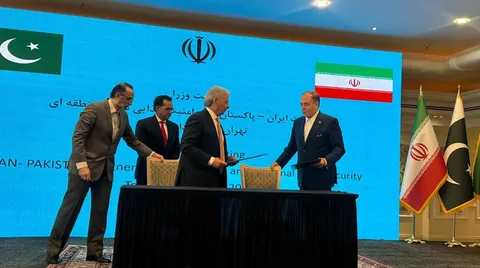

Islamabad/Tehran Iran Pakistan trade relations are entering a new and more active phase this year, as both neighboring countries work to triple their bilateral trade volume from roughly $3 billion to an ambitious $10 billion target. Officials from both sides have signed a series of agreements covering ports, logistics, agriculture and border trade, signaling that Iran Pakistan trade relations are no longer confined to informal border exchange but are shifting toward structured, long-term economic cooperation.
Background
Iran Pakistan trade relations have deep roots that go back to 1947, when Iran became one of the first countries to formally recognize Pakistan’s independence. Since then, Iran Pakistan relations have been shaped by religious bonds, shared history and cultural closeness, even as political tensions and border security issues have occasionally slowed progress. The two countries share a rugged 900-kilometer border that runs through Pakistan’s Balochistan province and Iran’s Sistan-Baluchestan region, an area that has long struggled with militancy and underdevelopment.
For decades, Iran Pakistan trade relations remained modest compared to the two countries’ true economic potential. Institutional mechanisms such as the Joint Economic Commission, the Joint Border Trade Committee and the Joint Trade Committee were created to formalize cooperation, and border sustenance markets were introduced to support communities living along the frontier. Despite these frameworks, actual trade volumes stayed well below what officials on both sides considered realistic.
Details
According to recent Iran Pakistan trade statistics, bilateral trade currently sits at around $2.8 billion to $3 billion annually, a figure both governments now view as far short of potential. Pakistan’s exports to Iran have historically been minimal, while imports from Iran — largely liquefied petroleum gas, bitumen, dates, coal tar and other raw materials — make up the bulk of the exchange. Pakistan’s trade deficit with Iran has been a recurring theme in Iran Pakistan trade relations, prompting renewed calls from officials to rebalance the relationship.
To address this gap, Pakistan and Iran have signed twelve separate agreements and memoranda of understanding covering trade, agriculture, science, technology, communications and maritime safety. These agreements are widely seen as the most comprehensive step taken in Iran Pakistan trade relations in recent years. A central part of the new push involves linking Pakistan’s Gwadar port with Iran’s Chabahar port, two facilities that officials on both sides now describe as complementary rather than competing.
Pakistan has also relaxed export rules to allow shipments of food, pharmaceuticals and tents to Iran, with onward transit into Central Asia through Iranian territory. Commerce Minister Jam Kamal Khan noted that trade routed through Iran would significantly cut costs and delivery times for Pakistani exporters, a development that officials believe could reshape Iran Pakistan trade relations over the coming years. New road routes connecting Pakistani ports with the Iranian border have further strengthened this corridor, easing congestion at Karachi port while giving Gwadar a long-awaited boost in activity.
Iran, meanwhile, has faced serious economic pressure following the U.S.-Israel conflict and the subsequent blockade of the Strait of Hormuz. Analysts say this has made Pakistan an increasingly important economic outlet for Tehran, with overland corridors through Gwadar, Karachi and Port Qasim into Iran via the Gabd and Taftan crossings now moving real cargo volume. This shift has added a new layer of urgency to Iran Pakistan trade relations, as Tehran looks to diversify its trade options beyond maritime routes affected by regional instability.
Quotes
Nasir Khan, vice president of the Federation of Pakistan Chambers of Commerce and Industry, said that with strategic coordination and the removal of technical trade barriers, reaching $10 billion in bilateral trade within a few years is highly achievable. He added that Gwadar and Chabahar ports could work together to help transform the wider region into a major global transit hub.
Mohammad Saeid Arbabi, CEO of the Chabahar Free Zone, described the Chabahar-Gwadar partnership as a strategic and complementary relationship, one that could strengthen economic ties between the two countries while boosting regional connectivity. Pakistani officials, including those from the commerce ministry, have echoed similar sentiments, describing Iran as a natural partner for expanding trade access into Central Asia.
Impact
The strengthening of Iran Pakistan trade relations carries implications well beyond the two countries themselves. For Pakistan, deeper trade ties with Iran offer a pathway to reduce reliance on costlier, longer shipping routes and provide new market access at a time when the country is working under a $7 billion IMF program to stabilize its economy. Expanded trade with Iran also gives Pakistani exporters, particularly in rice, meat, textiles and agri-based products, a growing regional market to tap into.
For Iran, closer Iran Pakistan trade relations offer a practical way to soften the economic impact of sanctions and the Hormuz blockade. Increased dependence on Pakistani transit routes has shifted some of the regional trade balance, with several analysts noting that Pakistan may now hold more leverage in the relationship than in previous decades. Regionally, the Gwadar-Chabahar linkage is being watched closely, since it connects two major infrastructure projects — Pakistan’s China-Pakistan Economic Corridor and Iran’s North-South Transport Corridor — that were once seen as rivals rather than partners.
Conclusion
Iran Pakistan trade relations appear to be entering their most active phase in years, driven by new port agreements, eased export restrictions and mutual economic necessity. While challenges remain, including border security concerns, sanctions-related restrictions and the slow pace of finalizing a full free trade agreement, both governments have signaled clear intent to move from informal border trade toward a structured, higher-volume economic partnership. If current agreements are implemented as planned, Iran Pakistan trade relations could look markedly different within the next few years, with the $10 billion target serving as the benchmark both sides are now working toward.
FAQs
Who is Pakistan’s second largest trading partner?
Pakistan’s trade relationships are led by a handful of major partners, with China typically ranking as its largest trading partner due to the scale of imports and CPEC-related trade. The United States has traditionally held a strong position as well, particularly as a leading destination for Pakistani textile and apparel exports, often placing it among the top two or three partners depending on the year and reporting source. Regional partners such as the UAE and Saudi Arabia also feature prominently, though Iran, despite geographic proximity and historic ties, currently accounts for a comparatively smaller share of Pakistan’s overall trade volume.
Who is Iran’s biggest trade partner?
Iran’s largest trading partner by a significant margin is China, which accounts for a substantial share of Iran’s oil exports as well as imported machinery, electronics and consumer goods. Other notable partners include the UAE, which serves as a major re-export and trade hub for Iranian goods, along with Iraq, Turkey and, to a growing extent, Pakistan. As sanctions have limited Iran’s access to Western markets, Tehran has increasingly leaned on regional neighbors, positioning Iran Pakistan trade relations as part of a broader strategy to diversify trade partnerships.
Which things does Pakistan import from Iran?
Pakistan’s imports from Iran are dominated by energy-related and raw material products, reflecting Iran’s role as a resource-rich neighbor. Liquefied petroleum gas and bitumen make up a large portion of these imports, alongside dates, coal tar, iron and steel products, and various agricultural goods. Smaller categories include plastics, organic chemicals, edible vegetables, dairy products and even carpets, showing that despite the relatively modest overall trade volume, the range of goods exchanged under current Iran Pakistan trade relations is fairly diverse.