


When a murder happens in Pakistan, solving it is rarely simple. Detectives cannot just rely on eyewitnesses or confessions. Courts want cold, hard proof. That is where forensic evidence steps in and it has quietly become one of the most important parts of criminal trials across the country.
Whether you are trying to understand a case in the news or looking for a forensic evidence in murder case PDF for academic research, this guide breaks down exactly how the process works in Pakistan, what types of evidence investigators collect, and why some cases succeed while others fall apart.
What Is Forensic Evidence in a Murder Case?
Forensic evidence is any physical, biological, or digital material collected from a crime scene that can be scientifically tested and presented in court. In a murder case in Pakistan, this means everything from blood samples and fingerprints to CCTV footage and bullet casings.
Pakistani courts do not treat forensic evidence as final proof on its own. According to established case law, forensic findings are considered corroborative they support or challenge other evidence like witness statements. A conviction cannot rest on forensic findings alone. But without them, most serious murder cases today struggle to reach a verdict.
Who Conducts Forensic Investigations in Pakistan?
Two main institutions handle forensic analysis in murder cases across Pakistan.
Punjab Forensic Science Agency (PFSA), based in Lahore, is the most advanced forensic lab in the country. Since its inception, PFSA has received more than 1.5 million pieces of evidence from around 100,000 cases every year. All high-profile cases across the country, including murders, homicides, sexual assaults, and cybercrimes, are referred to PFSA when needed. The agency runs 14 specialist departments, covering DNA, toxicology, firearms, digital forensics, and more.
National Forensic Science Agency (NFSA), operating from Islamabad, was set up in 2002 and offers services in crime scene investigation, forensic DNA, firearms and toolmarks, fingerprints, questioned documents, and explosives.
Both agencies play a direct role when police investigate murder cases, though PFSA is more frequently involved given its resources.
How Forensic Evidence Is Collected at a Murder Scene
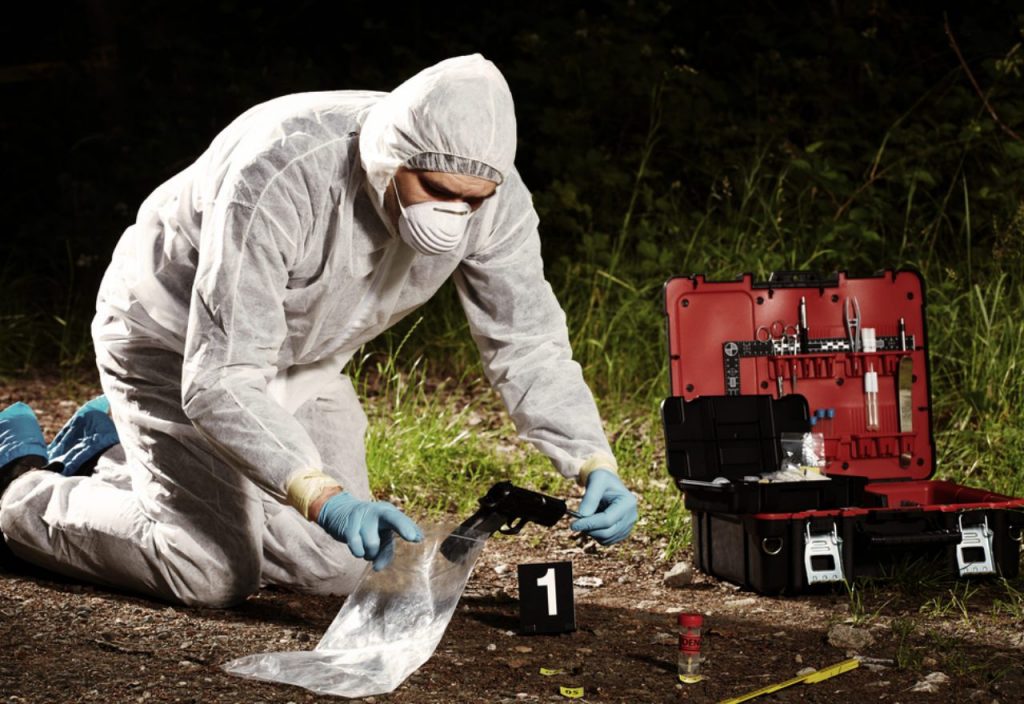
The process starts at the crime scene. Crime scene investigation units are now established in both PFSA, Lahore, and NFSA, Islamabad, though most crime scene processing is still handled by local police who often lack proper equipment and training. This is one of the weakest links in Pakistan’s forensic chain evidence mishandled at the scene can be rejected in court entirely.
Investigators are trained to follow a careful sequence. They photograph the scene, sketch the layout, collect biological and physical samples, and seal them properly before sending them to the lab. Any break in this chain can put the entire case at risk.
Types of Forensic Evidence Used in Pakistani Murder Cases
1. DNA Evidence
DNA is arguably the most powerful forensic evidence in a murder case in Pakistan today. DNA profiling is among the most used types of forensic evidence in Pakistan, and its application has been seen in high-profile cases such as the Zainab Ansari case and cases connected to Benazir Bhutto. Blood, hair roots, saliva, and skin cells can all yield a DNA profile that links a suspect to the scene.
Biological evidence always comes from an organism. In poisoning cases, blood and viscera are collected for toxicological testing. Saliva samples are obtained from cigarette butts, drinking containers, chewing gum, bite marks, and envelope adhesives.
2. Fingerprint Analysis
Fingerprints remain one of the oldest and most reliable forms of forensic evidence. PFSA and additional forensic labs in Pakistan use Automated Fingerprint Identification Systems (AFIS) to match latent prints from crime scenes against databases. In the Noor Mukadam murder case, the National Forensic Science Agency did not find the accused’s fingerprints on the knife, a detail that became a significant point of contention during the trial.
3. Ballistics
In shooting-related murders, forensic ballistics analysis is critical. Forensic ballistics experts analyze bullet trajectories, ammunition residues, and unique markings left on projectiles and casings by specific firearms. This helps determine the type of weapon used and potentially connect it to a suspect. Pakistani courts have accepted ballistics reports from PFSA labs as evidence in numerous firearms-related homicide convictions.
4. Toxicology
When poison is suspected, toxicology becomes the primary forensic tool. In one case in Punjab, post-mortem and forensic evidence revealed solid proof of poisoning after a victim’s body was exhumed. Investigators confirmed both the cause of death and the method used through lab analysis.
5. Digital Forensics
Phone records and CCTV footage now play a major role. In the Noor Mukadam case, mobile phones of both the suspect and the victim were sent to the Federal Investigation Agency for forensic analysis and retrieval of deleted data. Call data records (CDRs) are also commonly submitted in murder trials, though Pakistani courts have noted that CDR data alone is not conclusive proof of guilt.
6. Trace Evidence
Physical evidence includes fingerprints, tire marks, footprints, fibers, paint, and building materials. These trace elements are collected from the scene and compared against samples from suspects, victims, and their environments. Even a fiber from a carpet or a paint chip from a car door can place a suspect at a scene.
7. Questioned Documents and Forensic Photography
In cases involving financial motive or contract killings, questioned documents forged signatures, fabricated records are examined by PFSA specialists. Forensic photography documents the scene in detail and serves as a permanent visual record for court proceedings.
A Real Example: The Dr. Wardah Mushtaq Case
In Abbottabad, investigators recovered a concealed compartment at a suspect’s house. From the hidden space, police recovered the victim’s mobile phone, national identity card, ATM card, vehicle registration card, a photograph, and tools allegedly used in the crime, including a pick-axe and a shovel. Each of these items had to be processed forensically before they could be presented to a court.
Challenges Facing Forensic Evidence in Pakistan
The system is not without problems. As forensic science’s importance grows across the country, so does the case backlog. More cases arrive each day, causing delays in processing and ultimately delayed justice. There is a clear need to increase the capacity and number of forensic laboratories across Pakistan.
In one disturbing incident from Punjab, a forensic evidence report in a murder case was allegedly destroyed by a police sub-inspector who was accused of colluding with the accused party. A case was registered against the officer, but the damage to the case file had already been done. This kind of interference with forensic evidence in murder cases is a serious obstacle to justice in Pakistan.
How Forensic Evidence Holds Up in Pakistani Courts
Courts in Pakistan treat forensic science reports as supporting evidence, not standalone proof. Superior courts have consistently ruled that a conviction requires forensic findings to align with the testimony of witnesses and other material evidence. Where reports are incomplete, delayed, or tampered with, defense lawyers successfully challenge their admissibility.
That said, in cases where DNA, ballistics, and digital evidence all align, juries and judges find it very difficult to dismiss the cumulative picture they paint.
Impact: Why This Matters for Justice in Pakistan
When forensic evidence in a murder case is handled properly, it does more than solve a crime. It protects innocent people from wrongful convictions and makes it harder for the guilty to walk free on technicalities. Pakistan’s courts are slowly becoming more forensic-literate, and prosecutors are increasingly building cases around scientific evidence rather than relying solely on confessions or witness testimony.
The shift is slow, but it is real. Agencies like PFSA are training police officers and legal professionals to handle evidence better. The goal is a criminal justice system where no murder goes unsolved for lack of scientific capacity.
Conclusion
Forensic evidence in murder cases in Pakistan has come a long way from basic post-mortem reports. Today, DNA analysis, digital forensics, ballistics, and toxicology together form the backbone of serious criminal investigations. Agencies like PFSA and NFSA have built genuine scientific capacity, even if gaps in training, lab capacity, and evidence handling still hold the system back. For anyone researching this topic whether for a forensic evidence in murder case PDF, a legal case, or academic study understanding how the process works in Pakistan’s specific context is essential.
FAQs
What evidence is needed for a murder conviction in Pakistan?
Pakistani courts require a combination of evidence to secure a murder conviction. This typically includes a post-mortem report establishing the cause of death, forensic lab findings such as DNA, toxicology, or ballistics results, witness testimony, and often digital evidence like CCTV footage or call data records. Forensic evidence alone is not enough for a conviction under Pakistani law courts treat it as corroborative, meaning it must support and be supported by other forms of proof. If the forensic chain of custody is broken or reports are tampered with, that evidence may be rejected entirely.
What are the 7 types of evidence in criminal cases?
In criminal law, evidence is generally categorized into seven broad types. Physical evidence refers to tangible objects found at the crime scene, such as weapons, clothing, or tools. Biological evidence includes blood, DNA, saliva, and tissue samples. Testimonial evidence comes from witnesses, experts, or the accused. Documentary evidence covers written records, contracts, and digital files. Digital evidence includes phone records, CCTV footage, and data recovered from devices. Demonstrative evidence is used to illustrate or explain other evidence, such as maps or diagrams. Finally, circumstantial evidence points to a conclusion indirectly a suspect’s presence near a scene, financial motive, or prior threats. In Pakistan, courts weigh all seven types together rather than relying on any single category.
What are the 7 S’s in forensics?
The 7 S’s of forensic science are a framework investigators use when approaching a crime scene. The first is Secure the scene, meaning the area must be protected from contamination before anything else. Second is Separate the witnesses, keeping people apart so their accounts remain independent. Third is Scan the scene, where investigators take in the overall picture before touching anything. Fourth is See the scene, a closer and more detailed visual examination. Fifth is Sketch the scene, producing a rough diagram of evidence positions. Sixth is Search for evidence, the systematic process of finding and tagging every relevant item. Seventh is Secure and collect the evidence, packaging samples properly to maintain their integrity for laboratory testing. When these steps are followed correctly, the forensic evidence gathered is far more likely to stand up in a Pakistani court.