

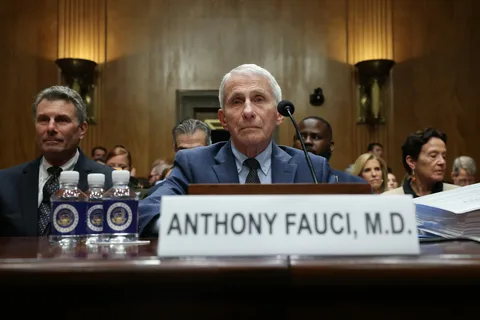

Dr. Anthony Fauci repeatedly invoked his 5th Amendment right against self-incrimination during a tense Senate hearing this week, declining to answer more than 100 questions from lawmakers investigating the origins of COVID-19. The decision has renewed public interest in what it actually means to plead the Fifth Amendment and when Americans are legally entitled to use it.
Background
Fauci, the former director of the National Institute of Allergy and Infectious Diseases, appeared Wednesday before the Senate Homeland Security and Governmental Affairs Committee, chaired by Kentucky Republican Rand Paul. Paul has spent years publicly accusing Fauci of misleading Congress about the pandemic’s origins and the government’s COVID-19 response.
Fauci was compelled to appear after being subpoenaed, and days before the hearing, Paul released more than 1,000 pages of Fauci’s private communications. Rather than answer questions directly, Fauci opened with a brief statement before invoking his 5th Amendment right against self-incrimination for the remainder of the roughly three-hour session.
This case has drawn fresh attention to Fifth Amendment examples in American political history, since high-profile witnesses invoking the privilege during congressional testimony is relatively rare and often draws intense scrutiny, both legal and political.
Details
Throughout the hearing, Fauci repeated a single line in response to nearly every question: “On the advice of counsel, I respectfully decline to answer based on my rights under the Fifth Amendment.” According to reporting from multiple outlets, he invoked the privilege more than 100 times.
In his opening statement, Fauci said it pained him to take this approach, citing decades of what he described as cooperative testimony before Congress. He argued that Paul’s true goal was to provoke a statement that could be used to pursue a perjury prosecution against him, something Fauci said Paul had publicly promised to achieve.
Understanding why is the 5th Amendment important in this context requires looking at Fauci’s legal situation. Former President Joe Biden issued Fauci a preemptive pardon in early 2025, covering potential federal offenses connected to his pandemic-era conduct. However, that pardon does not protect him from prosecution for anything he might say, or allegedly misstate, during this new round of testimony.
That legal gap explains why Fauci’s team advised him to plead the Fifth Amendment rather than answer questions. Legal experts note that self-incrimination protections exist specifically to prevent this kind of no-win scenario, where a witness could face prosecution either for past conduct or for statements made under oath in the present.
The hearing grew increasingly contentious as it continued. Committee Chairman Paul ordered Capitol Police to remove Fauci’s attorney, David Schertler, from the room after he attempted to speak on his client’s behalf without being formally recognized. Paul also announced the committee would vote next week on whether to hold Fauci in contempt of Congress over his refusal to answer questions.
Quotes
Fauci told the committee that the sole reason Paul had called him to testify was to prompt him into saying something that could be used to fulfill Paul’s repeated public promises that Fauci would end up, in Paul’s own words, “behind bars.”
Republican Senator Josh Hawley of Missouri criticized Fauci’s approach during the hearing, telling reporters that nothing communicates honesty quite like a witness taking the Fifth, a comment reflecting the skepticism several committee Republicans expressed toward Fauci’s legal strategy.
Fauci’s attorney, David Schertler, said afterward that his client has a valid Fifth Amendment privilege and the right to assert it, adding that this was the only point he had been trying to make to the committee before he was removed from the room.
Impact
The hearing has broader implications for how Americans understand their 5th Amendment right, since legal experts have used the moment to clarify that pleading the Fifth Amendment carries no implication of guilt or innocence. It is a constitutional protection available to any witness who reasonably fears that truthful testimony could expose them to criminal prosecution.
Politically, the hearing produced no new factual revelations about COVID-19’s origins or the government’s pandemic response, but it deepened the partisan divide over how Fauci’s legacy should be judged. Republicans used their time to criticize his past recommendations, while Democrats accused the committee of running a politically motivated proceeding.
The case also illustrates the limits of a presidential pardon. Even with Biden’s 2025 pardon in place, Fauci still faced meaningful legal exposure tied specifically to this hearing, a reminder that pardons typically apply only to conduct that occurred before they were issued.
Conclusion
With a contempt vote expected next week, the political fallout from Fauci’s decision to invoke the Fifth Amendment is far from over. The committee’s next steps will determine whether this becomes a prolonged legal standoff or a case that quietly fades once the immediate news cycle moves on.
For now, the hearing serves as a rare, high-profile reminder of how the 5th Amendment functions in practice. It’s also a reason to brush up on constitutional protections like the 4th Amendment and 6th Amendment, even for public figures who’ve spent decades testifying before Congress without incident.
Frequently Asked Questions
What’s the meaning of “I plead the fifth”?
When someone says, “I plead the Fifth,” they are invoking their constitutional right under the Fifth Amendment to refuse to answer a question because doing so might incriminate them in a criminal matter. The person doesn’t need to explain why they believe their answer could be self-incriminating, and courts have generally upheld broad protection for this right so long as it’s invoked in good faith. Importantly, using this protection is not an admission of guilt; it simply reflects a legal judgment, often made on a lawyer’s advice, that answering carries unnecessary legal risk.
What is a summary of the Fifth Amendment?
The Fifth Amendment to the US Constitution provides several protections for individuals facing the criminal justice system, with the right against self-incrimination being just one part of it. It also guarantees the right to a grand jury indictment for serious federal crimes, protection against double jeopardy (being tried twice for the same offense), the right to due process before the government can deprive someone of life, liberty, or property, and the right to fair compensation when private property is taken for public use. Together, these provisions make the Fifth Amendment one of the most frequently cited parts of the Bill of Rights in both criminal defense and civil proceedings, and its self-incrimination clause remains the aspect most people encounter through news coverage.
Why do we say plead the fifth?
The phrase comes directly from the Fifth Amendment’s text, which states that no person “shall be compelled in any criminal case to be a witness against himself.” Over time, the process of invoking this specific protection became shorthand in American legal and popular culture as “pleading the Fifth,” since it directly references the amendment number in the Bill of Rights. The phrase became especially well known through televised congressional hearings and courtroom dramas throughout the 20th century, cementing itself in everyday language even among people with no formal legal background, much as this week’s Fauci hearing has reintroduced the phrase to a new generation of viewers.