


Petroleum Dark Network: The Disappearing Billions between Storage and Sale and Its Impact on the Public
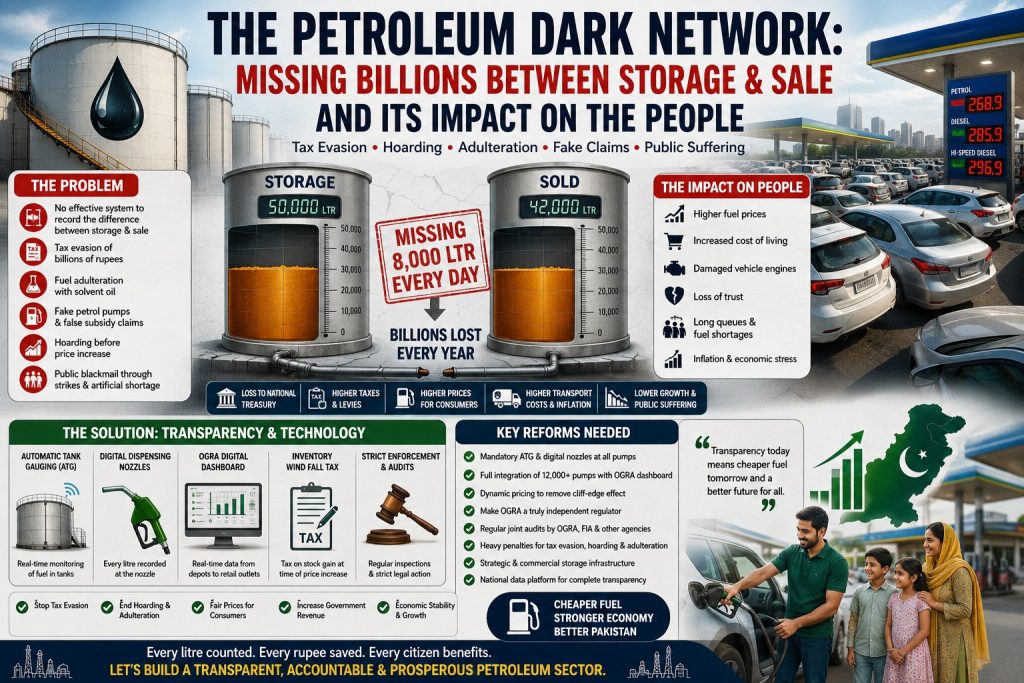
Pakistan’s petroleum sector is caught in a severe systemic crisis rooted in the absence of any effective mechanism to record the difference between storage at petrol pumps and actual sale through dispensing nozzles, this gap has not only become the single largest source of tax evasion but also provides petroleum dealers with a tool to blackmail both the government and the public, joint investigations by the Federal Investigation Agency and the Oil and Gas Regulatory Authority have revealed that billions of rupees are being evaded in taxes in the petroleum sector primarily because there is no automated and transparent system to record the difference between the fuel stored in underground tanks at petrol pumps and the fuel sold through nozzles, the government has introduced OGRA’s digital dashboard which is designed to provide real-time visibility of stock levels, sales, and supply conditions from depots to retail outlets in order to track changes in sales, inventory, and demand, however the Cabinet Committee on Petroleum Prices has acknowledged that data reporting from more than twelve thousand petrol pumps is far below the required level which prevents this dashboard from performing its full role, the biggest problem in the petroleum sector is that there is no mechanism to record the difference between the quantity of fuel present in the petrol pump tank and the quantity sold through the nozzle, modern technology offers digital dispensing nozzles and automatic tank gauges that can automatically record and monitor fuel quantities and check the actual fuel levels in underground tanks, but these technologies have not been widely implemented, if this system becomes fully functional then any abnormal difference between storage and sale at the pump such as leakage, theft, or calibration error would immediately appear without waiting until the end of the month, FIA investigations revealed that petroleum products kept in customs bonded warehouses were sold without paying duty, in one important case a case was registered against Gas and Oil Pakistan Limited and Terminal One Limited alleging that they sold customs bonded petroleum products without filing ex-bond goods declarations and without paying duty and levy, as a result of this scheme the national exchequer suffered a loss of approximately six billion rupees and discrepancies were found in records, physical stock, and supply chain documents for approximately forty-eight point six million liters of petroleum products, the Pakistan Petroleum Dealers Association warned the government that certain elements are mixing solvent oil into petrol and high-speed diesel to earn illegal profits, solvent oil is significantly cheaper and has a different tax regime applied to it, this adulteration damages vehicle engines, undermines consumer confidence, and causes major tax revenue losses to the government, investigations uncovered five hundred fake petrol pumps that remained closed for most of the year but suddenly became active when the government announced the price differential subsidy during the Iran-US conflict and submitted claims for billions of rupees in fictitious sales, OGRA asked the owners of these petrol pumps to provide electricity bills for eighteen months to check whether these stations were regularly operating or only became active during the subsidy period, however many owners did not submit electricity bills and claimed that their petrol pumps were entirely running on solar power, FIA has termed the mechanism for payment of price differential claims as flawed and unreasonable, according to investigations this system allows companies to claim compensation on old stock that was not affected by increases in refinery prices, PDC was calculated on the basis of sales volume rather than refinery purchases and OGRA ignored old and cheap inventories, in one example two oil marketing companies did not purchase products from local refineries nor did they import petroleum during the period from fourteen to twenty March two thousand twenty-six but still filed claims of fifteen point six million and fifteen point nine million rupees respectively which were processed and disbursed, petroleum dealers associations have repeatedly exerted pressure on the government through strikes, in July two thousand twenty-six the All Pakistan Petroleum Pump Owners Association threatened to close fifteen thousand petrol stations, the dealers main demands included opposition to the daily petroleum pricing system, increase in dealer commission from the current eight point six four rupees per liter to twenty-five rupees per liter representing eight percent profit, and the elimination of oil marketing companies supply quota, these strikes caused severe difficulties for the public which experts have termed a method of blackmailing the public, in Faisalabad and Swat the closure of petrol pumps forced citizens to face long queues and fuel shortages, according to a report petrol pump owners blackmail the public every fifteen days by opening only twenty percent of their pumps creating long queues, refusing to accept credit cards, and rationing fuel solely to benefit from price increases because their tanks contain seventy to eighty percent fuel as stock which is sold at the new price the next day, according to an investigative report by Pakistan Today the closure of petrol pumps before price increases is an inventory gain mechanism, when the government announces an increase in petroleum prices pump owners profit from the old stock in their underground tanks, on a small station with ten thousand liters of remaining stock one night’s profit amounts to one million three hundred seventy thousand rupees, on a medium station with twenty-five thousand liters it amounts to three million four hundred thirty thousand rupees, and on a large station with fifty thousand liters it amounts to six million eight hundred sixty thousand rupees, by this calculation for a large pump it is more profitable to remain closed from ten pm to twelve am rather than staying open because selling five thousand liters yields a legal commission of only forty-six thousand five hundred fifty rupees while saving the same fuel yields a profit of six hundred eighty-six thousand one hundred fifty rupees, in the current system there is an information

asymmetry where the dealer knows his tank level while the regulator makes estimates, as long as the state relies on physical checks dealers will always win, the government has directed the formation of joint teams comprising representatives from the Petroleum Division, OGRA, FIA, and Pakistan State Oil to prevent hoarding and illegal storage, these teams will be deployed at selected PSO pumps in Islamabad to ensure timely data entry, stock transparency, and operational compliance, amendments have been made to the Petroleum Act of nineteen thirty-four which include provisions for strict penalties and confiscation for illegal sales, storage, and transportation, according to joint research by the Islamabad Policy Research Institute and the Petroleum Institute of Pakistan the lack of strategic and commercial storage in Pakistan leaves the economy at the mercy of spot markets and energy security is a cornerstone of national security for which investment in storage infrastructure is indispensable, according to an investigative report by Republic Policy Pakistan’s energy crisis is not a pricing issue but an architectural issue, the report recommended establishing competitive markets, deregulating fuel prices, phasing out IFEM and freight equalization, making OGRA a truly independent regulator with enforceable licensing and transparent tariff determination powers, and establishing a national data platform that provides the public with honest data on stocks, imports, and circular debt, the government’s economic transformation plan focuses on resolving circular debt in the petroleum sector and restoring financial stability which includes implementing transparent pricing mechanisms, a circular debt settlement plan, efficient management of LNG imports, and reducing technical and financial losses, tax evasion and systemic corruption in the petroleum sector are causing annual losses of billions of rupees to the national exchequer, if the government fully implements the digital system to record the difference between storage and sale at petrol pumps then tax evasion can be controlled and proper taxes can be collected, the biggest benefit of this would be that the government would have the opportunity to reduce the rates of levy and petroleum development levy on petroleum products because the elimination of tax evasion would increase revenue and the government would no longer need to burden the public to meet its fiscal targets, in the current system tax evasion forces the government to keep levy rates high to compensate for revenue losses and this burden falls directly on ordinary consumers, if transparency is achieved in the petroleum sector and accurate records of every liter sold are available to the government then the tax net base would expand and the government could collect less tax per liter while still increasing total revenue, as a result retail prices of petroleum products would automatically decrease because a large portion of the price consists of taxes and levies, currently approximately sixty to seventy percent of the petrol price consists of various taxes and levies and if tax evasion is stopped and proper taxes are collected the government can reduce levy rates which would significantly reduce the per liter price, this means that the public would get petrol and diesel at cheaper rates which would reduce transportation costs and prices of essential commodities would also decrease because transportation costs would come down, inflation would decrease and the common man would get relief, in addition the prevention of tax evasion would end illegal profiteering and legitimate petroleum dealers would also get a competitive environment, the practice of petroleum dealers who hoard stock before price increases and sell at inflated prices would also be eliminated through digital monitoring, when every pump’s storage and sale data is available to the government in real time dealers will not be able to create artificial shortages before price increases nor will they be able to earn illegal profits on old stock, this would bring stability to the fuel supply chain and unexpected price increases would not occur, the government would also not face blackmailing from dealers because dealers would know that every action is being recorded and they cannot create pressure through strikes or artificial shortages, moreover the additional revenue generated from preventing tax evasion could be spent by the government on public welfare projects such as health, education, and infrastructure which would further strengthen the economy, overall transparency and digital monitoring in the petroleum sector would not only stop tax evasion but also reduce the tax burden on the public by providing them cheaper petroleum products which would significantly reduce daily living expenses and provide economic relief to the public, the success of reforms in Pakistan’s petroleum sector depends on the government prioritizing digital governance, making installation of ATG and digital nozzles mandatory at all petrol pumps, fully activating OGRA’s data dashboard and connecting all twelve thousand pumps to it, introducing an inventory windfall tax under which eighty percent of the price difference on existing stock would be collected at the time of price increases to eliminate the incentive for hoarding, making OGRA a truly independent regulator, converting the fortnightly pricing model to dynamic pricing to eliminate the cliff edge effect, having joint teams of FIA and OGRA conduct regular inspections of all pumps, taking strict legal action against dealers involved in tax evasion and hoarding, and establishing strategic and commercial storage facilities to ensure energy security, implementation of all these measures would bring transparency to the petroleum sector, end tax evasion, provide cheaper fuel to the public, reduce inflation, and stabilize the national economy, this is the urgent need of the hour for the government to make reforms in the petroleum sector its top priority and to cleanse this sector of corruption to provide relief to the public, because until real-time monitoring and data-based regulation are implemented corruption will continue in this sector and the public will continue to suffer from inflation and artificial shortages, reforming the petroleum sector does not only mean stopping tax evasion but providing justice to the public and empowering them economically, when the public gets cheap and quality fuel their purchasing power will increase, business activities will flourish, and the country will progress, therefore it is essential that the government takes practical steps in this direction and utilizes all possible resources to make the petroleum sector transparent and efficient, restoring public trust and stabilizing the economy requires reforms in the petroleum sector, and these reforms are only possible when modern technology is used to eliminate the gap between storage and sale and accurate records of every liter of fuel sold are available to the government, this would not only eliminate tax evasion but also end the blackmailing by petroleum dealers and provide the public relief from inflation and artificial shortages, Pakistan must modernize its petroleum sector according to contemporary requirements so that it can become transparent and efficient according to international standards and provide relief to the public.