

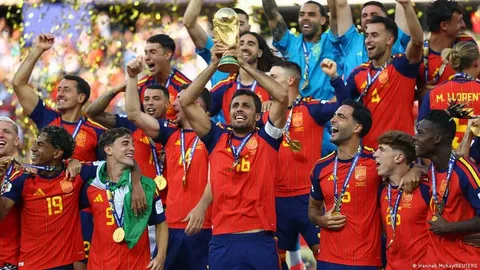

Spain did it again. On July 19, 2026, La Roja lifted the FIFA World Cup trophy for the second time in their history, defeating Argentina 1–0 in a dramatic extra-time final at MetLife Stadium in New Jersey. The Spain football team players 2026 wrote their names into football history, carrying a nation’s pride across an entire tournament and doing it in style.
This article breaks down everything you need to know about the Spain football team 2026 the full squad list with numbers, the captain leading the charge, the coach behind the tactics, the legends who came before, and what this generation means for Spanish football.
Spain Football Team Coach – Luis de la Fuente
Before talking about the players, you have to talk about the man who built this team. Luis de la Fuente has been the Spain football team coach since December 2022, and his record speaks for itself in a way that very few managers in international football can match.
Under De la Fuente, Spain won the UEFA Nations League in 2023, the UEFA Euro 2024 championship, and now the 2026 FIFA World Cup. He has turned a talented generation of players into a trophy-winning machine, doing it with calm authority and a clear tactical identity.
De la Fuente stated he evaluates form rather than club allegiance, which explains some of his bold selection calls including, famously, leaving out every single Real Madrid player from the 2026 World Cup squad. That decision raised eyebrows, but the results proved him right. His man-management skills and ability to connect with young players many of whom he first coached in the youth system have made him one of the most respected coaches on the international stage right now.
Captain of Spain Football Team 2026 – Rodri
Manchester City midfielder Rodri wears the captain’s armband for Spain at the 2026 World Cup, and the captaincy could not sit on more deserving shoulders. The Spain football team captain is not just a leader in title he is the heartbeat of everything De la Fuente’s team does on the pitch.
Rodri won the Ballon d’Or in 2024, the highest individual honour in football. He suffered a serious knee injury that kept him out for most of the 2024–25 club season, and there were genuine concerns about whether he would be fit for the World Cup. He missed most of the 2024/25 club season with a knee injury but is back to full fitness. He came back stronger, anchored Spain’s midfield throughout the tournament, and lifted the World Cup as captain. That is the kind of story that becomes football folklore.
Spain World Cup Squad 2026 – Full Players List and Numbers
Here is the complete Spain World Cup squad 2026 players list, as officially announced by coach Luis de la Fuente on May 25, 2026:
Goalkeepers:
Unai Simon (Athletic Club), David Raya (Arsenal), Joan Garcia (Barcelona)
Defenders:
Pedro Porro, Marcos Llorente, Aymeric Laporte, Pau Cubarsí, Marc Pubill, Eric Garcia, Marc Cucurella, Alejandro Grimaldo
Midfielders:
Rodrigo Hernandez (Rodri), Martin Zubimendi, Pedri Gonzalez, Fabian Ruiz, Mikel Merino, Pablo Paez (Gavi), Alex Baena
Forwards:
Mikel Oyarzabal, Lamine Yamal, Ferran Torres, Borja Iglesias, Dani Olmo, Victor Munoz, Nico Williams, Yeremy Pino
For the first time in Spain’s World Cup history, no Real Madrid player made the cut. Seventeen of the 26 players came from Spanish clubs, with Barcelona providing eight players alone. Seven players were based in the Premier League. It was a squad built on form, not reputation — and it worked perfectly.
Spain Lineup Today – How Spain Played at the 2026 World Cup Final
The Spain lineup today against Argentina in the World Cup final was a masterclass in tactical setup and collective intelligence. De la Fuente set up his side in a fluid 4-3-3, with Rodri as the deep-lying midfielder controlling the tempo from the base of the midfield. Pedri and Fabian Ruiz operated around him, giving Spain control in the middle third.
Argentina failed to muster a shot across 90 minutes, and only Emiliano Martinez’s heroics kept Spain at bay. The Spanish shape was suffocating pressing high, winning the ball quickly, and recycling possession with the kind of rhythm that has defined the best Spain teams across generations.
Spain dominated this final from start to finish. Their possession, movement, and pressing were relentless. Lamine Yamal caused problems all game on the right wing. Mikel Merino was dangerous from midfield. And when the match went to extra time after Argentina’s Enzo Fernandez was sent off for a second yellow card, Spain found the goal they deserved.
Substitute Ferran Torres eventually slammed home at the start of the second period of extra time, sending Spain fans across the world into absolute delirium.
Spain Team Photo 2026 – Key Players Who Defined the Tournament
Beyond the full squad list, a handful of Spain football team players 2026 truly defined this World Cup run. If you look at the Spain team photo 2026, you will see a generation of players who are young, technically brilliant, and completely fearless. Here are the standout names:
Lamine Yamal At just 18 years old, Yamal was arguably the most exciting player at the entire 2026 World Cup. Playing on the right wing for Barcelona and now for Spain, he scored against Saudi Arabia and won the decisive penalty against France. A World Cup final between Yamal and Messi became the generational duel the tournament had been building toward.
Mikel Merino The Arsenal midfielder became Spain’s big-game specialist. Merino headed a late winner against Portugal and struck in stoppage time to sink Belgium. His aerial threat and runs from midfield gave De la Fuente a game changer to call on in tight matches.
Ferran Torres He came off the bench in the final and delivered when it mattered most. His extra-time strike won Spain the World Cup and wrote his name permanently into La Roja’s history books.
Pau Cubarsí Cubarsí is 19 and already one of the best defenders in the world. His composure and reading of the game throughout the tournament were extraordinary for someone his age.
David Raya The Arsenal goalkeeper was solid throughout the competition, providing a safe pair of hands whenever Spain needed him.
Spain Football Players Legends – The Icons Who Came Before
To understand why Spain winning the 2026 World Cup is so significant, you need to understand the legacy these players have inherited. The Spain football players legends list is one of the most impressive in world football men who built the foundation this generation now stands on.
Andres Iniesta is widely considered the greatest Spain footballer of all time. He scored the winning goal in the 2010 World Cup final, cementing his place in Spanish football folklore. His partnership with Xavi formed the core of Barcelona’s and Spain’s midfield. Their telepathic understanding redefined how attacking midfield football looked.
Xavi Hernandez is regarded as one of the greatest central midfielders in history. His accuracy, vision, and ability to control tempo were unmatched during Spain’s golden era. He was essential for both his club and his country, winning UEFA Euro 2008, the 2010 FIFA World Cup, and UEFA Euro 2012.
Iker Casillas is among the greatest goalkeepers the game has ever seen. He made 167 appearances for Spain and was a key part of their victories in the 2010 FIFA World Cup and UEFA Euro 2008 and 2012. Known for his quick reflexes and strong leadership, he captained Spain during their golden era.
Sergio Ramos remains one of the most decorated defenders in history and one of Spain’s most successful captains. He holds the record for most caps for the Spanish national team with 180 appearances. His leadership, his goals from set pieces, and his sheer winning mentality made him a legend at both Real Madrid and La Roja.
David Villa is Spain’s all-time top scorer. David Villa holds the record as Spain’s top scorer with 59 goals. His finishing, his movement, and his ability to score in critical moments made him indispensable to the greatest Spain team ever assembled.
These are the men whose footsteps the 2026 squad followed and now, this new generation has matched their achievements.
Spain’s Road to the 2026 World Cup Final
Luis de la Fuente’s side, led by captain Rodri, topped Group H after drawing with Cabo Verde before beating Saudi Arabia and Uruguay. They then eliminated Austria in the round of 32, Portugal in the last 16, Belgium in the quarter-finals and France in the semi-finals.Every knockout match brought a different hero. Merino won it against Portugal and Belgium. Yamal was the creative heartbeat against France. And Torres delivered the decisive blow in the final itself. It was a true team effort across the entire tournament which is, really, the most Spanish way to win.
Global Impact of Spain’s 2026 World Cup Win
Spain’s victory carries enormous significance beyond the trophy itself. It confirms this team as the dominant force in world football right now, with a core group of players who are still in their early-to-mid twenties. Lamine Yamal is 18. Pau Cubarsí is 19. These players have potentially a decade at the top level ahead of them.
It was a bitter way for Argentina’s campaign to end, but even Messi will concede Spain were worthy winners. For context, Spain finished with an expected goals (xG) total of 1.94 from their 20 shots, compared to Argentina’s 0.2 from just two attempts. That stat says everything about how dominant La Roja were throughout the match.
The scenes in Madrid and across Spain told the story. Fans in Madrid celebrated Spain’s goal in extra time in scenes described as unreal. For a country that had to wait 16 years between its first and second World Cup titles, this felt like both a completion and a beginning.
Conclusion – A New Chapter in Spanish Football History
Spain came to the 2026 World Cup as European champions. They are leaving as world champions. The Spain football team players 2026 led by captain Rodri, coached by Luis de la Fuente, and inspired by the brilliance of Lamine Yamal, Mikel Merino, and Ferran Torres delivered a campaign that will be remembered for generations.
The Spain football players legends of the golden era Iniesta, Xavi, Casillas, Ramos, Villa built the culture, the identity, and the winning mentality. The 2026 squad has now matched everything those legends achieved. And with the average age of this squad sitting well below 26, the future looks extraordinary.
La Roja are world champions again. And this might just be the start of something even bigger.
Frequently Asked Questions (FAQs)
What will Spain be like in 2050?
If the current trajectory of Spanish football continues, Spain in 2050 could be looking at a generation built on the foundations of what Lamine Yamal, Pau Cubarsí, and their contemporaries are establishing right now. Spain’s football infrastructure from La Masia at Barcelona to the RFEF youth development system produces technically excellent players at a rate that almost no other country can match. By 2050, having won their second World Cup in 2026 with a squad averaging under 24 years of age, Spain could realistically have added more major trophies to their collection. The emphasis on positional play, ball control, and tactical intelligence has been embedded at youth level for decades, meaning the pipeline of elite talent remains consistently strong. Spain in 2050 is likely to remain one of the top three or four footballing nations in the world, assuming current investment in academies and coaching education continues.
Where is Spain vs Argentina playing?
The 2026 FIFA World Cup Final between Spain and Argentina took place at MetLife Stadium in New Jersey, United States also referred to as the New York/New Jersey Stadium — on July 19, 2026. The match kicked off at 7:00 PM local time and went to extra time, with Spain winning 1–0 thanks to Ferran Torres’s goal in the 106th minute. MetLife Stadium, which has a capacity of over 82,000, hosted the tournament’s showpiece event in front of a packed crowd that included US President Donald Trump and other high-profile guests. The atmosphere inside the ground was electric from the first whistle, with both sets of fans creating an unforgettable occasion.
Is Spain good for New Year’s?
Spain is genuinely one of the best countries in Europe to celebrate New Year’s. The Spanish New Year’s tradition is unique and deeply cultural at midnight, people eat twelve grapes, one for each chime of the clock, representing good luck for the twelve months ahead. The biggest celebrations happen in Madrid’s Puerta del Sol square, where hundreds of thousands of people gather for the countdown, and in Barcelona’s various city-wide events. With Spain now riding the high of their 2026 World Cup victory just months earlier, New Year’s 2026–2027 is expected to feel even more celebratory than usual across the country. The combination of warm winter weather in coastal cities like Valencia and Barcelona, vibrant nightlife, world-class food, and genuine festive street culture makes Spain one of the top New Year’s destinations in the world.