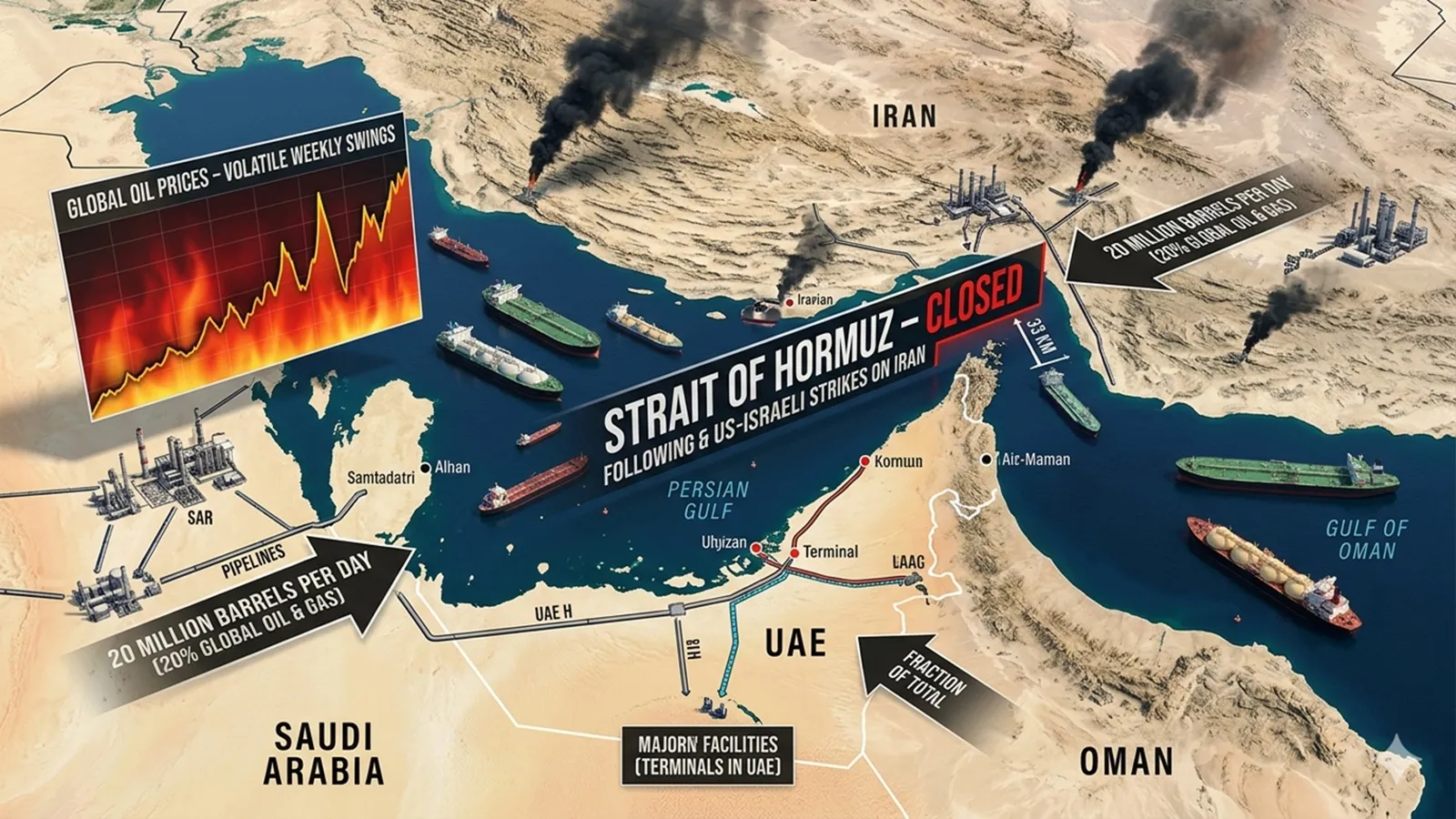
The Strait of Hormuz map is once again at the center of global attention as fresh military strikes between the United States and Iran threaten one of the world’s most vital oil shipping lanes. Brent crude jumped sharply this week, with Iran claiming the strait is now closed “until further notice,” while US Central Command insists ships are still moving freely through the waterway. The conflicting claims have left shipping companies, insurers, and energy markets on edge, and millions of people worldwide are searching for a Strait of Hormuz map live to understand exactly where the danger zone lies.
Background: Why the Strait of Hormuz Keeps Making Headlines
The Strait of Hormuz has been a flashpoint since February 2026, when the United States and Israel launched coordinated strikes against Iran. In response, Iranian forces declared the strait closed and began targeting commercial vessels attempting to pass through it. A temporary memorandum of understanding briefly eased tensions in June, but the calm did not last long.
Anyone checking a Strait of Hormuz Google map will notice how narrow this waterway truly is. It links the Persian Gulf to the Gulf of Oman and the wider Arabian Sea, with Iran sitting along its northern coastline and Oman controlling the southern shore. At its narrowest point, the strait is only about 33 kilometers wide, and the shipping lanes used by tankers are even tighter, making it extremely vulnerable to blockades, mines, and missile strikes.
Details: What Is Happening Right Now
Over the past week, the situation escalated quickly. US Central Command launched strikes against Iranian targets after Iranian forces attacked commercial ships transiting Hormuz, including tankers linked to Qatar and Saudi Arabia. Iran responded with missile and drone strikes on US military facilities in Bahrain, Kuwait, Jordan, and Oman.
Iranian state media then announced that the Revolutionary Guard had shut the strait “until further notice,” a claim the United States quickly rejected. American officials say naval forces remain deployed to guarantee freedom of navigation and that tanker traffic, though reduced, has not fully stopped. Maritime tracking firms reported that only a handful of vessels moved through the strait over the weekend, a steep drop from normal traffic levels before the crisis began.
This back-and-forth is exactly why so many people are now typing Strait of Hormuz closed into search engines, hoping for a clear, updated answer. The truth right now is somewhere in between: the strait is not fully sealed, but it is far from safe, and insurers have sharply raised war-risk premiums for any vessel attempting the crossing.
Strait of Hormuz Is Controlled by Which Country?
This is one of the most searched questions connected to the crisis, and the answer is more complicated than a single name. Geographically, the strait sits between Iran to the north and Oman to the south, which means Hormuz Strait between which countries technically involves both nations sharing territorial waters along the passage.
However, under international maritime law, the Strait of Hormuz is recognized as an international waterway, meaning no single country has the legal right to close it to global shipping. Iran disputes this interpretation, arguing that parts of the strait fall within its territorial waters and that it has the authority to restrict passage during wartime. The United States and most of the international community reject that claim, insisting the strait must remain open under the principle of “innocent passage” guaranteed by the United Nations Convention on the Law of the Sea.
Impact: Why the Strait of Hormuz Importance Cannot Be Overstated
Understanding the Strait of Hormuz importance helps explain why every skirmish here sends oil prices soaring within hours. Before this crisis began, roughly one-fifth of the world’s oil and a significant share of global liquefied natural gas passed through this single channel every single day. Asian economies, particularly China, India, and Japan, rely heavily on crude that moves through this route, while Gulf nations depend on it to export their energy products to the rest of the world.
Any disruption here does not stay regional for long. Brent crude has already climbed toward the high $70s per barrel as traders price in the risk of prolonged closures or repeated attacks. Shipping insurance costs have surged, some carriers are rerouting vessels around the southern Omani coastline to avoid the most dangerous stretch, and global supply chains for fertilizer, LNG, and refined fuel are all feeling the pressure. Analysts warn that if the standoff continues for weeks rather than days, consumers around the world could see the effects at the pump.
Expert and Official Reactions
US Central Command stated that its forces are positioned to ensure freedom of navigation despite what it called unwarranted Iranian aggression, adding that traffic through the strait continues to flow. Iranian state media, on the other hand, maintains that the Revolutionary Guard has effectively shut the waterway to protect Iranian sovereignty. Energy analysts tracking the region say Iran likely cannot enforce a complete blockade indefinitely, but that sporadic strikes are enough to keep global markets nervous and oil prices elevated for the foreseeable future.
Conclusion: What Happens Next
The coming days will be critical in determining whether this latest flare-up settles back into an uneasy ceasefire or spirals into a longer confrontation. Diplomatic talks have been floated in Doha, Qatar, though neither side has confirmed a firm date. Until a durable agreement is reached, expect continued volatility in oil markets, more searches for a live Strait of Hormuz world map, and heightened caution from shipping companies navigating one of the most contested waterways on the planet.
Frequently Asked Questions
Why is Iran attacking ships in the Strait of Hormuz?
Iran’s attacks on commercial vessels in the Strait of Hormuz are widely viewed as retaliation for US and Israeli military strikes on Iranian territory that began in February 2026. Iranian officials argue that as long as their country remains under attack, they have the right to restrict or disrupt shipping through waters they consider partly within their sovereignty. Analysts also suggest Iran is using the threat of disruption as a bargaining tool to pressure Washington into lifting sanctions and easing military pressure, since the strait is one of the few points of leverage Tehran holds over the global economy. The attacks have targeted tankers linked to countries seen as aligned with US interests, including vessels connected to Qatar and Saudi Arabia, rather than random or unprovoked violence.
Can Iran close the Strait of Hormuz legally?
Under international law, specifically the United Nations Convention on the Law of the Sea, the Strait of Hormuz is classified as an international strait, which means all countries are entitled to the right of transit passage through it, regardless of territorial claims by bordering nations. This means that, legally speaking, Iran does not have the unilateral authority to shut the strait to global shipping, even though parts of it fall within Iranian and Omani territorial waters. Iran has disputed this interpretation for decades and has periodically threatened closure during past conflicts, including tensions in the 1980s and again in 2019. In practice, while Iran cannot “legally” close the strait, it can make passage extremely dangerous through military force, mines, and missile attacks, which has a similar practical effect on shipping traffic even without formal legal backing.
Where is 90% of Iran’s oil?
The vast majority of Iran’s crude oil exports, historically estimated at around 90 percent, are shipped through Kharg Island, a key export terminal located in the Persian Gulf near Iran’s southwestern coast. From Kharg Island, tankers must pass through the Strait of Hormuz to reach international markets, particularly buyers in China and other parts of Asia. This dependency is significant because it means Iran itself relies heavily on the strait remaining functional for its own oil revenue, which is part of why analysts believe a total, prolonged closure would ultimately hurt Iran’s economy as much as it disrupts global markets.