

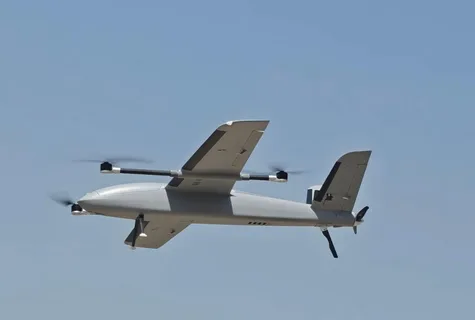

Terra Industries Nigeria has become one of the most closely watched startups on the continent. The Abuja-based company builds AI-powered drones and autonomous security systems for critical infrastructure. Its rapid growth, fresh funding rounds, and expansion plans have placed Nigeria’s drone industry firmly on the global map.
Background
Terra Industries was founded in Abuja in 2024. Two young Nigerians, 23-year-old Maxwell Maduka and 22-year-old Nathan Nwachuku, started the company and launched what they describe as the largest drone factory in Africa in February 2025.
The founders built Terra Industries around a simple but urgent problem. Attacks on power plants, mines, and oil facilities remain common across the continent, and the company set out to build autonomous security systems powered by artificial intelligence to protect these assets.
Terra Industries Nigeria did not begin as a defense contractor. It started under the name TerraHaptix before rebranding. The company began producing drones in Abuja in April 2024 and quickly built revenue from commercial customers in the oil, mining, and agriculture sectors across Nigeria, Ghana, and Kenya.
Details
The scale of Terra Industries drone production has grown quickly. Reports indicate the company is building capacity that could reach 30,000 drones per year, with key components including airframes, propellers, and battery systems produced in-house.
This local manufacturing approach matters for Nigeria’s drone industry. The company’s growth comes as global supply chains face pressure, U.S. policy tightens restrictions on foreign-made drones, and demand grows across public safety, infrastructure, and industrial markets.
Terra drones Nigeria are also priced competitively against foreign alternatives. One report noted that Terra’s drones can cost up to 55% less than comparable international systems, a factor that could significantly widen adoption in cost-sensitive markets.
The reach of Terra Industries extends well beyond Nigeria’s borders. The company already exports its drones to eight African countries and Canada, protecting an estimated $11 billion worth of assets, according to the co-founder and CEO.
Expansion is a central theme in the company’s recent story. Terra Industries announced construction of Pax-2, a second manufacturing facility, located in Accra, Ghana, which will serve as the company’s primary regional defense manufacturing base for drone and counter-drone systems. The facility sits on a 3,150-square-meter site and is expected to reach an annual production capacity of 50,000 units by 2028, with commissioning targeted for the end of June 2026.
Terra Industries Funding and Growth
Investor interest in Terra Industries has grown alongside its operational expansion. The company raised $11.75 million from more than half a dozen backers, including 8VC, the venture capital firm run by Palantir co-founder Joe Lonsdale.
That funding round attracted a notable list of participants. The round saw participation from Valor Equity Partners, Lux Capital, SV Angel, Silent Ventures, Nova Global, Leblon Capital, and angel investors including Micky Malka. Terra Industries funding later expanded further to support its Ghana facility. The Pax-2 announcement followed a $34 million raise aimed at scaling manufacturing capacity, accelerating deployments, and growing engineering teams across Nigeria and allied African countries.
Despite the scale of its ambitions, Terra Industries has operated with relatively modest capital for much of its history. The CEO noted the company had raised less than $600,000 while reaching $1.9 million in revenue at one stage of its growth.
It is worth noting that Terra Industries remains a privately held startup. It is not listed on any public stock exchange, so there is no Terra Industries share price available to investors at this time. Funding has come entirely through private venture capital rounds rather than public markets.
Quotes
Company leadership has been vocal about the mission behind Terra Industries Nigeria’s growth. Nwachuku said the company’s broader goal is to help industrialize Africa, adding that solving insecurity is the common denominator standing in the way.
On data sovereignty, the CEO explained the company’s approach to software and information handling. Nwachuku said the company must keep data within African hands, a principle behind its partnership with a local cloud platform rather than global providers.
Regional security experts have also weighed in on why companies like Terra Industries matter. Oluwole Ojewale, regional coordinator for Central Africa at the Institute for Security Studies, said critical attacks on strategic infrastructure directly impact economic development, citing how pipeline attacks in Nigeria have hindered the country’s oil production targets.
On the Ghana expansion, the company’s leadership framed the move as part of a larger continental vision. Terra Industries stated that lasting peace in Africa requires uniting to build sovereign defense rather than relying on foreign security architecture, describing the Ghana factory as part of that broader plan.
Impact
The rise of Terra Industries carries implications well beyond Nigeria’s drone industry alone. For years, the global drone market has been split between Chinese mass production and higher-cost, compliance-driven Western systems, and Terra Industries is positioning itself as a potential third path combining local manufacturing, lower costs, and AI-driven software.
This shift also matters at a time of rising insecurity across parts of Africa. Non-state actors are increasingly deploying modified commercial and fiber-optic drones as attack systems, a tactic already seen in conflicts in the Middle East and Eastern Europe, which is driving demand for integrated defense systems combining surveillance, electronic warfare, and response capability.
Terra Industries’ commercial contracts also illustrate its growing regional footprint. The company won a $1.2 million contract to secure two hydropower plants, beating a rival bid from an Israeli consortium, supplying a dozen drones and more than 35 surveillance towers.
The broader economic case for Terra drones Nigeria is also gaining attention from regional business media. The company reports contracts worth tens of millions of dollars and a pipeline spanning public and private sector projects, including power plants in Nigeria and mining sites in both Nigeria and Ghana.
Conclusion
Terra Industries Nigeria is positioning itself as Africa’s leading defense-technology manufacturer, backed by growing investor confidence and expanding production capacity. With the Ghana facility set to become the continent’s largest drone factory and new contracts continuing to arrive, the company’s next phase of growth will be closely watched across Africa’s security and technology sectors. As demand for homegrown defense solutions rises, Terra Industries’ trajectory could shape how African nations approach infrastructure protection in the years ahead.
FAQs
Which country is the largest producer of drones?
China remains the largest global producer of drones, dominating both commercial and military drone manufacturing due to its extensive supply chains, established component industries, and large-scale production facilities. However, emerging manufacturers in regions like Africa, including Nigeria’s Terra Industries, are beginning to challenge this dominance in specific niche markets by offering lower-cost, locally built alternatives tailored to regional security and infrastructure needs.
Is drone banned in Nigeria?
Drones are not entirely banned in Nigeria, but their use is regulated by the Nigerian Civil Aviation Authority (NCAA), which requires registration, permits, and compliance with airspace rules for commercial and certain private drone operations. Companies like Terra Industries operate within this regulatory framework, working with government and private clients to deploy drones legally for infrastructure security, surveillance, and industrial monitoring purposes across the country.
Who is the owner of Terra Industries Nigeria?
Terra Industries was co-founded in 2024 by Nigerian engineers Nathan Nwachuku, who serves as CEO, and Maxwell Maduka. Both founders were in their early twenties when they built the company from a small operation into what is now considered one of Africa’s most prominent drone and autonomous defense technology manufacturers, with backing from international venture capital investors.