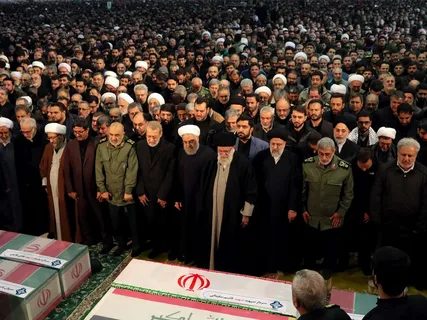
Iran has entered one of the most sensitive chapters of its modern history. A dayslong state funeral for assassinated Supreme Leader Ayatollah Ali Khamenei began this week in Tehran. Huge crowds gathered at the Imam Khomeini Mosalla as officials, clerics, and foreign dignitaries paid tribute. The event has reopened global questions about the Iran political system, its ruling structure, and the future of the biggest political party in Iran.
Summary
Ali Khamenei, who led Iran for more than three and a half decades, was killed on February 28, 2026, in a joint US-Israeli strike on his residence in Tehran. His funeral, delayed for months due to the ongoing conflict, finally began in early July 2026. The procession is moving through Tehran, Qom, Karbala, Najaf, and Mashhad before his burial. The funeral has become a moment for the world to examine how the Iran political system actually functions, and whether Iran should be classified as a democracy or an autocracy.
Background
Iran’s Islamic Republic was founded in 1979 after the revolution that removed the monarchy. Since then, the Iran political system has combined elected institutions with unelected clerical bodies that hold final authority. The Supreme Leader sits at the top of this structure. He commands the armed forces, appoints judiciary heads, and controls state media.
Ali Khamenei became Supreme Leader in 1989 after the death of Ayatollah Ruhollah Khomeini. He remained in power for nearly 36 years. During his rule, power stayed concentrated among conservative and hardline factions. Reformist voices existed within parliament, but they rarely controlled the true levers of power.
The Iran political history timeline shows repeated cycles of protest, crackdown, and limited reform. Major uprisings occurred in 2009, 2019, and again during the 2025 to 2026 nationwide protests. Human rights groups say thousands were killed in the crackdown that followed the most recent unrest, which set the stage for the war that eventually claimed Khamenei’s life.
Details
Khamenei was assassinated in Tehran as part of a broader Israeli and American operation targeting senior Iranian officials. Iranian state media confirmed his death on March 1, 2026, after days of denial. His daughter, son-in-law, daughter-in-law, and granddaughter were also killed in the strikes on his compound.
Because Iran has no formal deputy Supreme Leader position, a three-member Interim Leadership Council took charge under Article 111 of the constitution. This council included President Masoud Pezeshkian, Chief Justice Gholam-Hossein Mohseni-Ejei, and senior cleric Alireza Arafi. The council managed state affairs while the Assembly of Experts, an 88-member clerical body, worked to choose a permanent successor.
On March 8, 2026, the Assembly of Experts named Mojtaba Khamenei, the late leader’s son, as the new Supreme Leader. This decision surprised many analysts. Succession by direct bloodline had never happened before in the Islamic Republic. Critics argue the move shows how the Iran political system prioritizes internal power preservation over its own stated religious principles.
The funeral itself began on July 4, 2026, at the Imam Khomeini Mosalla in Tehran. Millions were expected to attend across the multi-day ceremonies. The coffin traveled through Islamic Revolution Square before heading toward Qom. From there, the procession is expected to cross into Iraq, visiting the Shia holy cities of Najaf and Karbala, before Khamenei is finally buried in his birthplace of Mashhad.
Iran Political Parties and the Question of Democracy
People often ask whether Iran is a democracy or autocracy. The honest answer sits somewhere in between, though most political scientists lean toward calling it an autocracy with limited electoral features. Iran does hold elections for president and parliament. However, the Guardian Council, which is controlled indirectly by the Supreme Leader, vets every candidate before they can run.
There is no single ruling party in the Western sense. Instead, Iran political parties operate more like loose factions or blocs rather than formal party organizations. The two broadest camps are the conservative or principlist bloc and the reformist bloc. The biggest political party in Iran, in practical terms, is not a party at all but the conservative establishment tied to the IRGC and the clerical elite.
Smaller registered groups do exist, including the Islamic Iran Participation Front, the Combatant Clergy Association, and the Islamic Coalition Party. However, how many political parties in Iran actually hold influence is a different question entirely. Most real power rests with unelected bodies like the Guardian Council, the Expediency Discernment Council, and the IRGC, not with any parliamentary party.
The political ideology of Iran centers on Velayat-e Faqih, or Guardianship of the Islamic Jurist. This doctrine holds that a senior Shia cleric should oversee the state until the return of the Twelfth Imam. This ideology forms the philosophical backbone behind the Supreme Leader’s authority and explains why the position carries both religious and political weight.
Quotes
Ayatollah Alireza Arafi, a member of the interim council, has publicly emphasized continuity within the ruling system during the transition period. Analysts at the Middle East Institute have noted that installing a family successor could create friction within Iran’s clerical and political leadership going forward.
A young Iranian woman who lost a family member during the 2025 protests told NPR that the state funeral gave her little comfort, saying the loss still weighs heavily on her family. Her comments reflect a wider divide between the government’s mourning rituals and public sentiment among younger Iranians.
International observers, including researchers writing for The Conversation, argue that the succession process has never been fully free or transparent. They point out that the same clerical structure that selects the Assembly of Experts also indirectly screens who can serve within it.
Impact
The funeral and succession crisis carry consequences far beyond Iran’s borders. Regionally, the war triggered retaliatory strikes across Gulf states and raised fears of a wider Middle East conflict. A fragile ceasefire is currently holding after the signing of the Islamabad Memorandum of Understanding, though tensions remain high.
Globally, foreign leaders and delegations, including from Pakistan, attended the funeral proceedings, signaling continued diplomatic engagement despite Iran’s international isolation. Oil markets, shipping routes, and regional security arrangements all remain sensitive to further instability coming out of Tehran.
Domestically, the political system of Iran now faces a legitimacy test. Mojtaba Khamenei inherits leadership during wartime, economic strain, and lingering public anger from the 2025 to 2026 protest crackdown. How he manages the Assembly of Experts, the IRGC, and reformist pressure will shape Iran’s political direction for years to come.
Conclusion
The funeral of Ali Khamenei marks the symbolic close of a nearly four-decade era in Iranian politics. Yet it also opens a new and uncertain chapter for the Iran political system. Questions about Iran political parties, the true distribution of power, and whether meaningful reform is possible remain unresolved.
As Mojtaba Khamenei settles into his role and the ceasefire with the United States and Israel is tested over time, the world will be watching closely. Future developments around Iran’s political history timeline, its relationship with regional powers, and internal dissent will determine whether this transition brings stability or further upheaval.
Frequently Asked Questions
Who controls the Strait of Hormuz?
The Strait of Hormuz sits along Iran’s southern coast and is patrolled primarily by Iran’s naval forces, including units of the Islamic Revolutionary Guard Corps Navy. It is one of the world’s most important oil transit corridors, with a large share of global seaborne crude oil passing through it daily. While Iran does not legally control international shipping through the strait, its military presence gives it significant leverage. During periods of heightened tension, including the recent conflict with Israel and the United States, Iran has repeatedly signaled its ability to disrupt traffic through the strait, drawing concern from global energy markets and international shipping companies that rely on this narrow waterway connecting the Persian Gulf to the Gulf of Oman.
Is Iran a fully developed nation?
No, Iran is generally classified as a developing country rather than a fully developed nation. It has a diversified economy with significant oil and gas reserves, a large industrial base, and a well-educated population, but it also faces serious economic challenges. Decades of international sanctions, currency devaluation, inflation, and restricted access to global banking systems have slowed development considerably. Human development indicators such as healthcare access, education levels, and urbanization are moderate to strong in parts of the country, particularly in major cities like Tehran. However, income inequality, unemployment among youth, and infrastructure gaps in rural provinces continue to hold back Iran’s overall development compared to fully industrialized nations.
How is Iran’s political system set up?
Iran’s political system is a unique hybrid that combines elements of a theocracy with limited republican institutions. At the top sits the Supreme Leader, currently Mojtaba Khamenei, who holds ultimate authority over the military, judiciary, and state broadcasting. Below him sits an elected president and a 290-seat parliament called the Majlis, both chosen through popular vote. However, the Guardian Council, whose members are appointed directly or indirectly by the Supreme Leader, vets every candidate before elections take place. The Assembly of Experts, an 88-member clerical body, is constitutionally responsible for selecting and theoretically removing the Supreme Leader. This layered structure means that while ordinary Iranians do vote, the range of political choices available to them is tightly controlled from above.