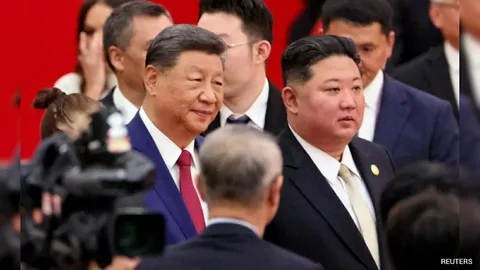
China and North Korea’s friendship is “unbreakable,” Xi Jinping declared during his June 8-9 state visit to Pyongyang — his first trip to North Korea in seven years and his first overseas visit of 2026. Kim Jong-un received the Chinese leader from what analysts described as an unusually strong position, with North Korea’s weapons program more advanced than at Xi’s last visit and its economy recovering after pandemic isolation.
Anniversary diplomatic messages exchanged July 1 have reinforced the same theme, with Kim Jong-un hailing the two countries’ “unshakeable will” to deepen ties. The relationship is as prominent as it’s been in years, and the June summit left a number of pointed signals about where it’s headed.
Background
China and North Korea have maintained close political and diplomatic ties for more than seven decades, a relationship built during the Korean War when China entered the conflict to prevent UN-led forces from reaching its border.
Since then, Beijing has remained North Korea’s largest trading partner and most important diplomatic backer. The year 2026 marks the 65th anniversary of the Treaty of Friendship, Cooperation and Mutual Assistance between China and North Korea the only mutual defense treaty Beijing has ever signed with any country making this year particularly significant for both governments.
A China and North Korea map shows the two countries share a border of roughly 1,350 kilometers. That geography is part of why Beijing treats stability on the Korean Peninsula as a core national security interest rather than a secondary diplomatic concern.
Kim Jong-un Reaffirms Close Partnership with Xi Jinping
Xi arrived at Pyongyang International Airport on June 8 to a ceremonial welcome: Kim and his wife Ri Sol-ju at the tarmac, a 21-gun salute at Kim Il Sung Square, the Korean People’s Army honor guard, and thousands of workers and schoolchildren waving flags and releasing balloons.
Xi told Kim that ties were at a “new historical starting point” and urged stronger exchanges across diplomacy, law enforcement, military, agriculture, trade, technology, and construction. He said that “no matter how the international situation changes,” China’s stance on valuing the friendship would not change, that support for Kim Jong-un’s leadership would not change, and that China’s determination to safeguard common interests would not change.
Kim’s response was pointed. He said Xi’s visit “clearly demonstrates how unbreakable” the relationship is. North Korean newspaper Rodong Sinmun called it a demonstration of the “invincibility” of their partnership.
The timing was deliberate on both sides. Xi’s visit came just weeks after he separately hosted Russian President Vladimir Putin and US President Donald Trump in Beijing, playing to Beijing’s efforts to position China as a versatile global power broker.
North Korea and China President: A Relationship Worth Watching
The relationship between the North Korea and China President pairing of Kim Jong-un and Xi Jinping is one of the most closely observed in Asia, partly because it’s recently shifted in dynamics.
Kim was hosting Xi from a position of rare strength this time. His backing of Russia’s war in Ukraine has paid dividends, his weapons program has cemented North Korea’s status as a de facto nuclear state, and the economy has rebounded since its pandemic collapse.
For Beijing, the visit was also an opportunity to reassert its role as North Korea’s most critical economic and diplomatic partner, amid growing Russia-North Korea ties that have given Pyongyang more room to maneuver than it once had.
Is China and North Korea Friends?
Yes — but the answer requires some texture. China and North Korea describe themselves as strategic partners, bound by history and shared interests. The relationship is real and durable.
At the same time, Beijing did not publicly echo Washington’s claim that both sides agreed on the shared goal of denuclearizing North Korea. And in Pyongyang, Xi made no public mention of denuclearization at all, which was noticed by analysts who’ve tracked China’s public statements on the issue for years.
China has backed UN sanctions against North Korea’s nuclear program in the past. Whether it continues to do so actively, or whether the deeper alignment of interests in 2026 shifts that calculus, is one of the more consequential open questions surrounding this relationship.
Would China Defend North Korea in a War?
Would China defend North Korea in a war remains one of the most contested questions in international security analysis, and the June summit didn’t resolve it.
The 1961 Treaty of Friendship, Cooperation and Mutual Assistance contains mutual assistance provisions, and it’s the only such treaty Beijing has signed with any country. But treaty language and actual military commitments in a live conflict are different things.
Most analysts think any Chinese response would be shaped by:
- Who initiated the conflict and how it was perceived internationally
- Whether China’s own territory or direct interests were immediately threatened
- The risk of drawing in the United States or escalating to nuclear exchange
- The economic and diplomatic costs of intervention versus non-intervention
Craig Singleton at the Foundation for Defense of Democracies described the relationship as Beijing still viewing Pyongyang as “a strategic asset.” That framing — strategic asset rather than automatic ally — is probably the most accurate way to understand China’s likely calculations in a crisis. Protecting a strategic asset doesn’t automatically mean military intervention, especially if the conflict was triggered by North Korea’s own actions.
Why Did China Support North Korea in the Korean War?
Understanding why did China support North Korea in the Korean War requires looking at the strategic situation of 1950 specifically.
Chinese leadership feared that US-led UN forces advancing toward the Chinese border represented a direct threat to national security. North Korea served as a critical buffer state between China and American military influence on the peninsula.
Ideological alignment mattered too. Both governments shared communist political systems at the start of the Cold War, and Beijing saw the Korean conflict as part of a broader struggle against Western encirclement.
China deployed hundreds of thousands of troops, significantly affecting the war’s outcome and establishing the division of the Korean Peninsula that still exists today. That history is part of why the 1961 treaty was signed, and why it remains in force 65 years later.
Does China Support North Korea or South Korea?
Does China support North Korea or South Korea is a question that reflects real complexity in Chinese foreign policy.
China has extensive economic ties with South Korea, making Seoul one of its more significant trading partners. At the same time, China maintains its historical strategic relationship with Pyongyang. Rather than choosing sides outright, Beijing tries to run both relationships simultaneously.
Some analysts warn this approach carries risks: closer China-North Korea alignment could prompt South Korea and Japan to strengthen their own security relations with Washington, which is precisely what Beijing doesn’t want.
China’s stated position is peace, denuclearization, and stability on the Korean Peninsula. In practice, that means encouraging dialogue and discouraging actions that could trigger a military confrontation, regardless of which Korea is involved.
China and North Korea Difference
Close allies, but not similar countries. The China and North Korea difference runs across multiple dimensions.
Political and Economic System
Both are governed by communist parties, but China has embraced market-oriented economic reforms that have made it the world’s second-largest economy. North Korea operates under a highly centralized state-controlled system and remains one of the world’s most isolated economies.
International Relations
China maintains formal diplomatic relations with most countries. North Korea’s diplomatic network is far smaller, and extensive international sanctions limit its external engagement significantly.
Military
China possesses one of the world’s largest and most technologically advanced armed forces. North Korea maintains a large standing army but has far fewer advanced conventional capabilities, though it does have nuclear weapons and an expanding ballistic missile program, which changes the military equation entirely.
China vs North Korea: Who Would Win?
The China vs North Korea who would win framing is essentially hypothetical, since the two are allies and conflict between them is not a realistic near-term scenario.
That said: on conventional military metrics, China’s advantages are overwhelming. Military technology, air power, naval capability, defense spending, industrial production, logistics, and cyber capability all favor China by wide margins.
The complication is North Korea’s nuclear weapons. Whatever the conventional balance, a nuclear-armed state can alter the calculus of any conflict in ways that raw military comparisons don’t capture. The more relevant point is that both countries know this, which is part of why their relationship despite occasional friction over North Korea’s weapons program has stayed functional.
Regional and Global Impact
Security analysts note that Xi and Kim’s remarks suggest broader ambitions beyond the Korean Peninsula, potentially including North Korea’s involvement in wider regional flashpoints including Taiwan.
The United States, South Korea, and Japan all track the China-North Korea relationship closely for exactly this reason. Alongside China and Russia, North Korea and Iran share an interest in blunting US power and straining its alliances a grouping sometimes described as “CRINK” that reflects a loose but real alignment of interests against the US-led international order.
Whether that alignment is genuinely cohesive or more transactional depends on the issue and the moment, but Trump discussed the Korean Peninsula with Xi during his May visit to Beijing, and North Korea’s nuclear posture is likely to remain a recurring point of tension between Washington and Beijing regardless of their relationship on other issues.
Future Outlook
China and North Korea are expected to continue expanding diplomatic exchanges and political coordination following the June summit. Air China resumed flights between the capitals in March, border crossings have resumed after pandemic closure, and both sides agreed on “important consensus” during the Pyongyang talks.
Whether that translates into genuine economic cooperation or stays primarily symbolic is worth watching. The sustainability of improved North Korea-Russia and North Korea-China relations will likely influence how long Kim can continue to resist pressure from Washington and Seoul on the nuclear question.
Beijing will continue managing its relationships with both Koreas and with Washington simultaneously, trying to stay relevant to the outcome on the peninsula without being pulled into a conflict it doesn’t want. That’s a difficult balance, and the June summit suggests Xi has decided that keeping Pyongyang close is a higher priority right now than maintaining the posture on denuclearization.
Frequently Asked Questions (FAQs)
Has Kim Jong-un been to China?
Yes, multiple times. Kim has visited China several times since taking power, meeting Xi Jinping in Beijing and Dalian between 2018 and 2019. His September 2025 trip to Beijing was his first visit in six years, made to attend the 80th anniversary of China Victory Day alongside Vladimir Putin. That visit, plus Xi’s June 2026 return trip to Pyongyang, makes this the most active period of China-North Korea leadership engagement in years. The pattern reflects just how central Beijing remains to North Korea’s foreign policy, despite Pyongyang’s growing ties with Moscow.
What is China’s opinion on North Korea?
China views North Korea as a strategically important neighbor and ally, but its approach has always been carefully balanced. Beijing’s stated priorities are stability, peace, and denuclearization of the Korean Peninsula. In practice, that has sometimes meant supporting UN sanctions on North Korea’s nuclear program and sometimes meant shielding Pyongyang from additional international pressure, depending on what serves China’s broader regional interests at a given moment. The June 2026 summit notably produced no public mention of denuclearization from either leader, which suggests Beijing is currently prioritizing the alliance relationship over pressing Pyongyang on weapons.
Is Korea friendly with China?
Both Koreas maintain relationships with China, but they’re very different. North Korea and China share a close historical and strategic partnership built over seven decades, reinforced by the 1961 mutual assistance treaty and demonstrated by Xi Jinping’s June 2026 state visit to Pyongyang. South Korea and China have strong economic ties and maintain formal diplomatic relations, but there are real political tensions, particularly over regional security, THAAD missile defense deployments, and Beijing’s close relationship with Pyongyang. China is trying to manage both relationships simultaneously, though the two sets of interests don’t always align easily.