
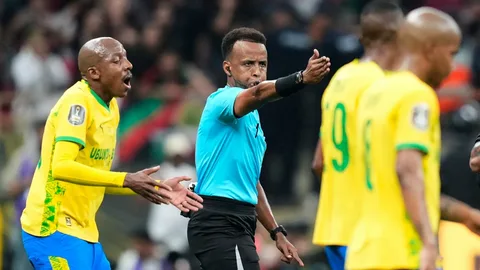
Omar Artan, Somalia’s most recognized football referee, has been removed from FIFA’s World Cup 2026 officiating schedule after the United States denied him entry into the country. The decision came after travel complications made it impossible for him to attend FIFA-related activities, and the football world took notice quickly.
The Somali world cup referee story spread fast, especially across African and Middle Eastern football communities where Omar Artan’s World Cup appointment had already been celebrated as a genuine milestone. Reactions ranged from disappointment to outright frustration and the broader question of how visa politics intersects with international sport has not gone away.
FIFA Removes Somali Official From Tournament Duties
FIFA confirmed the removal after the Somali referee denied US entry issue made his participation impossible. Officials reviewed the circumstances and reorganized the officiating lineup for upcoming fixtures tied to World Cup 2026 preparations.
Artan had been expected to officiate matches as part of the tournament build-up. That assignment is now gone. The reshuffle required FIFA to redistribute responsibilities across the remaining officiating pool, adding logistical pressure at an already busy stage of preparations.
For African football supporters, this was not just a scheduling problem. Omar Artan’s World Cup involvement had represented something proof that a Somali official could reach the sport’s biggest stage. Losing that, under these circumstances, stung.
Who Is Omar Artan?
Omar Artan has spent years building a reputation as one of East Africa’s most reliable football referees. He has officiated across FIFA and CAF competitions, handling high-pressure matches involving national teams from across the continent. His style is measured calm under pressure, firm when needed.
The Somali world cup referee name started appearing more widely after he officiated important qualifying matches and continental fixtures. People began searching for Somali world cup referee Wikipedia entries to piece together his career. What they found was a consistent record at international level, built over years in a country where sports infrastructure has rarely been easy to navigate.
Artan’s career has also served as a reference point for younger Somali referees. Making it to FIFA-level officiating from Somalia is not straightforward. He did it anyway.
Visa Problems Create International Debate
The Somali referee denied US entry news triggered a wider argument about whether immigration processes are compatible with the demands of global sporting events. Critics say officials selected for international tournaments should not have to fight through the same travel barriers as ordinary visa applicants. The timelines simply do not work.
Hosting a tournament as large as FIFA World Cup 2026 requires governments, immigration agencies, and sports bodies to coordinate properly. When that coordination breaks down, the first people to feel it are the ones with the least leverage officials and representatives from smaller football nations.
Some supporters argued the incident should push FIFA to negotiate stronger travel guarantees for officials ahead of the tournament. Others pointed out that visa decisions remain the sovereign right of host governments and FIFA has limited ability to override them. Both points are fair. Neither makes the outcome less frustrating.
Growing Interest in Somali Football Representation
The Omar Artan referee World Cup 2026 situation has pulled wider attention toward Somali football which is not a conversation that gets much space in global sports media.
Somalia has faced decades of political instability, and sports infrastructure has suffered alongside everything else. Getting a referee to FIFA level under those conditions is a real achievement, not a token one. Many Somali football fans understood that clearly, which is why the removal landed as hard as it did.
Searches for Somali world cup referee age and career history jumped sharply after the story broke. People wanted to know who he was. That kind of attention is rare for Somali sport, and it matters even when the circumstances behind it are unfortunate.
African referees generally get fewer international assignments than their European or South American counterparts. Artan’s appointment had pushed back against that trend, at least for a moment.
FIFA Yet to Announce Long-Term Decision
Omar Artan’s future in international competition beyond this incident has not been formally addressed by FIFA. Whether he remains in consideration for other assignments going forward is still unclear.
The situation has, however, added pressure on FIFA to think more carefully about how it supports officials from nations that face routine travel difficulties. World Cup 2026 spans three host countries and involves referees from dozens of nations. The logistical and immigration challenges are not going to get simpler as the tournament gets closer.
Some analysts believe the Somali world cup referee case could push FIFA toward establishing clearer travel support frameworks for future appointments. Others are skeptical that institutional change happens that quickly. Time will tell.
Somali Referee Salary Discussions Trend Online
Alongside the controversy, searches for Somali world cup referee salary figures picked up significantly. It is a natural question people wanted to understand what was at stake professionally.
FIFA referees working at World Cup level earn through a combination of match fees, preparation allowances, and tournament bonuses. Experienced officials assigned to the main event can earn substantial amounts, though FIFA does not typically publish individual figures. For a referee from Somalia, where sports earnings are generally modest, a World Cup assignment carries real financial weight on top of the professional significance.
The public interest in referee pay also reflects something broader football officiating as a career path is getting more attention in countries where the sport is growing but formal opportunities are still limited.
International Sports and Immigration Challenges
This is not the first time an international sports event has been disrupted by a visa denial. Athletes, journalists, and officials have run into similar walls at previous tournaments. Each time it happens, the same conversation restarts and each time, it does not seem to produce lasting solutions.
The scale of World Cup 2026 makes this harder to ignore. The tournament involves more teams, more officials, and more international movement than any previous edition. Incidents like the Omar Artan World Cup situation will not be isolated if better systems are not in place.
For Somalia, the case has grown beyond football. Citizens from developing nations navigating international bureaucracy recognize the pattern immediately. The football story is just one version of a much older frustration.
Reactions From Football Community
The response from African football communities was largely one of disappointment. Omar Artan had earned his FIFA appointment through years of consistent work. Losing it to a visa denial not a performance issue, not a conduct problem felt arbitrary to many who followed his career.
Commentators praised his professionalism and pointed out that experienced referees are not easy to replace on short notice. FIFA’s officiating operations depend on officials who know how to handle high-stakes matches. Pulling one out at this stage creates real gaps.
A smaller number of voices urged patience, noting that the full details of the entry denial are not yet public. That is a reasonable position. It does not make the outcome easier to accept.
Future of Omar Artan in International Football
The setback is real, but it is probably not the end of Omar Artan’s international career. His FIFA standing and CAF experience still place him among the most capable referees Somalia has produced. Those credentials do not disappear because of one visa decision.
There is also an argument that this incident, as difficult as it is, has brought more international attention to Somali officiating than years of matches ever did. Whether that attention translates into future opportunities is an open question but the name is now known in circles where it was not before.
The Somali world cup referee story is unlikely to fade quickly from World Cup 2026 discussions. It sits at the intersection of sport, immigration, and representation in ways that tend to keep conversations alive.
FAQs
Who is the most famous referee in the World Cup?
Pierluigi Collina from Italy is widely considered the most iconic World Cup referee in history. His distinctive appearance and commanding presence made him immediately recognizable, and his officiating in major finals including the 2002 World Cup final cemented his reputation. Howard Webb from England is another frequently named figure, known for handling the 2010 World Cup final between Spain and the Netherlands. Collina, though, is the name that comes up first in almost any conversation about legendary referees.
Are Somalis African or Arab?
Somalis are ethnically African and Somalia sits in the Horn of East Africa. The country also has deep historical and cultural ties to the Arab world shared religion, trade history, and geographic proximity to the Arabian Peninsula which is why Somalia holds membership in the Arab League. In practice, Somalis are African by geography and ethnicity, with strong Arab cultural connections layered on top of that identity.
How much do FIFA refs get paid?
FIFA referees earn through match fees, preparation allowances, and tournament bonuses and the figures climb significantly at World Cup level. Elite referees assigned to knockout rounds or finals can earn tens of thousands of dollars over the course of a major tournament. FIFA does not publish individual earnings, so exact numbers are difficult to confirm, but international officiating at the highest level is financially meaningful, particularly for referees from countries with limited domestic sports economies.