

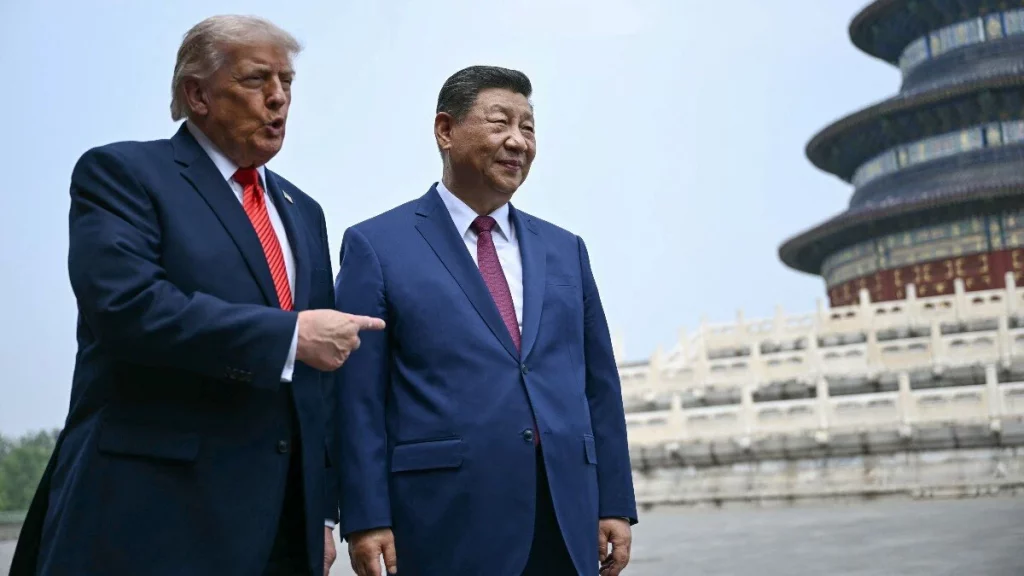

The Trump Xi business-first relationship is taking shape after a two-day summit in Beijing that put economic cooperation front and centre while quietly setting aside some of the most combustible issues between the world’s two largest economies. Both leaders left the Chinese capital projecting warmth, signing off on a shared framework, and signalling that 2026 could mark a turning point in a relationship that spent most of 2025 on the edge of collapse.
Early signs point to the United States and China moving towards a relationship focused on pragmatic areas of common interest following US President Donald Trump’s trip to China, according to analysts, setting aside the turmoil that marked 2025.
What Is Going On Between the US and China Right Now
Trump was in Beijing for three days this week to meet with Chinese President Xi Jinping, accompanied by a delegation of American CEOs, including the heads of Apple, Nvidia, BlackRock and Goldman Sachs.
The presence of that business delegation said more than any joint statement. This was not primarily a diplomatic summit it was a commercial opening. Both sides wanted business leaders in the room, and both sides got them.
The US and China agreed to forge more cooperative ties at their summit in Beijing, in a high-stakes meeting full of friendly gestures between two countries that have been battling for years on issues ranging from intellectual property and human rights to technology and trade.
Chinese President Xi Jinping and US President Donald Trump agreed to develop a “constructive China-US relationship of strategic stability,” according to Beijing’s official English readout of the summit.
US and China Relationship: What Both Leaders Said
Trump said the relationship between the two countries went back to the founding of the US, noting that the early American traders who visited China were described, by the Chinese, as “the new people.” Today, he said, the two countries’ bilateral ties were among “the most consequential” in the world.
Xi said: “I have always believed that the common interests between China and the US outweigh the differences. Let 2026 be a historic and landmark year for Sino-US relations to carry on the past and open up the future.”
The Chinese president said the two countries should become partners, rather than rivals, adding that “mutual respect is key to stable China-US ties.”
Xi, while less effusive, spoke of his desire to move towards a new US-China framework based on “constructive strategic stability”, meaning the US and China should try to “minimise competition, manage differences and allow stability to be the foundation of the bilateral relationship.”
Background: How the US-China Relationship Got Here
The road to Beijing was not smooth. The summit was delayed in March following the US and Israeli strikes on Iran. It marks the first state visit to China from a US president since 2017, when Trump was first in office.
The trade war of 2025 defined the first phase of Trump’s second term. China was the first major economy to retaliate against Trump’s “liberation day” tariffs in April 2025. When Xi threatened to restrict rare earth mineral flows in April and October 2025, Trump folded rather than credibly threaten escalation.
The meeting between the two leaders came just over six months after they agreed to pause the US-China trade war for a year on the sidelines of a multilateral summit in South Korea. In return for China’s agreement to pause restrictions on rare-earth metal exports, Trump dropped a threat of 100 percent tariffs on Chinese goods.
That truce set the stage for Beijing. Both sides came in wanting to bank what they had rather than risk losing it.
What Was Agreed and What Was Avoided
While a frequent critic of China’s economic policies at home, Trump appeared to get along with Xi in person throughout his trip and lavished praise on the Chinese leader.
Trump and Xi discussed trade, with Xi saying that China’s door of opportunity will open wider. Trump will be hoping it includes a Chinese pledge to buy US soybeans, beef and aircraft.
On the Iran war, agreement was partial. Chucheng Feng, founding partner of Hutong Research based in Beijing, told Al Jazeera that the omissions reflect that Xi and Trump still disagree on key issues, including Iran, but that the overall message from the summit was a desire to move forward. “For Beijing, the most important thing is to find a floor for the relationship, to set up and enhance guardrails so that no surprises or uncontrolled escalations suddenly emerge.”
Taiwan was addressed bluntly. Xi said “the Taiwan question is the most important issue in China-US relations”, adding: “If it is handled properly, the bilateral relationship will enjoy overall stability. Otherwise, the two countries will have clashes and even conflicts, putting the entire relationship in great jeopardy.”
Trump did not push back publicly. Both sides left Taiwan where they found it unresolved, but contained for now.
Expert Analysis: Can the Trump Xi Business-First Relationship Last?
Analysts are cautious about how durable this reset will prove. China feels confident enough to be able to stand up to Trump on many key issues, including sanctions, technology controls, critical minerals, and Iran.
“China comes into this meeting far more confident than in 2017, when it feared even a small rise in US tariffs. In the last year, Xi has been able to push back and neutralize much of Trump’s actions,” said Scott Kennedy, senior adviser and trustee chair in Chinese Business and Economics at the Center for Strategic and International Studies.
The Beijing summit will likely represent a relatively modest step toward greater stability and predictability in the world’s most important bilateral relationship. Like every president who goes to Beijing, Trump faces outsized expectations against the backdrop of a much more complex and challenging relationship.
The business-first framing is real, but it has limits. Trade deals take months to finalise. Technology restrictions remain in place on both sides. And the Iran war still unresolved continues to generate friction that no summit communiqué can paper over.
Global Impact: What the US-China Relationship Means for the World
China’s 15th Five-Year Plan, unveiled in March 2026, places far greater emphasis on resilience in an era of mounting uncertainty. From President Xi and his lieutenants, the message is unambiguous: resilience and technological self-reliance are not temporary adjustments to external pressure, but enduring strategic priorities.
This matters because a China committed to self-reliance is a China that will keep investing in domestic manufacturing, alternative supply chains, and non-Western trade networks regardless of how warm any given Trump-Xi summit feels. The business-first relationship is real at the margins. It is not a structural reset.
For the rest of the world, the stakes are high. The Council on Foreign Relations described the meeting as an effort to stabilise US-China relations rather than resolve long-standing disputes. It cited continuing disagreements over China’s economic policies, Taiwan, freedom of navigation in the South China Sea, and Beijing’s relations with countries viewed by the United States as strategic adversaries, including Russia, Iran, and North Korea.
What Comes Next
The next test of the Trump Xi business-first relationship will come quickly. Trade commitments need to be translated into signed agreements. The Strait of Hormuz remains effectively closed, and China’s role in pressuring Iran toward a deal or not will define whether Beijing is a genuine partner or simply a quieter rival.
For now, both leaders chose cooperation over confrontation. That choice is meaningful. Whether it survives the next crisis over Taiwan, over trade enforcement, over Iran is the question that no Beijing banquet can answer.