The Bodleian Library Oxford is not just a building it is a living piece of world history. Founded over 420 years ago, it stands as one of the oldest and most celebrated research libraries on the planet. Every year, thousands of visitors and scholars walk through its doors, drawn by its extraordinary collections, breathtaking architecture, and timeless significance.
Whether you are a history lover, a Harry Potter fan, or simply curious about what is the Bodleian Library, this complete guide covers everything you need to know.
What Is the Bodleian Library?
The Bodleian Library is the main research library of the University of Oxford. Founded in 1602 by Sir Thomas Bodley, it is one of the oldest libraries in Europe. With over 13 million printed items, it is the second-largest library in Britain after the British Library.
Unlike public or lending libraries, the Bodleian operates primarily as a reference library meaning documents generally may not be removed from the reading rooms. Scholars from around the world travel to Oxford specifically to access materials that simply cannot be found anywhere else.
Known to Oxford scholars as “Bodley” or “the Bod,” it is one of six legal deposit libraries in the United Kingdom, entitled to receive a copy of every book published in the country. This single privilege has allowed its collection to grow into one of the most comprehensive in human history.
Bodleian Library History: From Medieval Roots to Global Fame
The First Oxford Library (14th Century)
The Bodleian Library history stretches far beyond 1602. The University’s first purpose-built library was begun in approximately 1320 in the University Church of St Mary the Virgin a building at the heart of Oxford’s academic quarter, close to the schools where lectures were given.
This small collection of chained books was founded under the will of Thomas Cobham, Bishop of Worcester. When Humphrey, Duke of Gloucester donated a great collection of manuscripts between 1435 and 1437, the space was deemed insufficient and a larger building was required.
Duke Humfrey’s Library (1488) The Oldest Library in Oxford
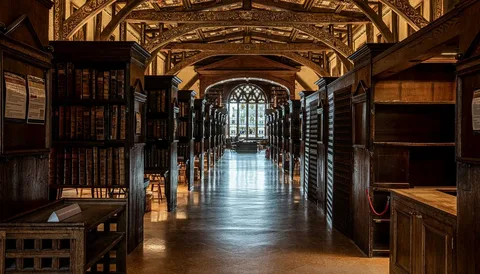
A new library was built over the Divinity School, begun in 1478 and finally opened in 1488. This room continues to be known as Duke Humfrey’s Library. Humfrey, Duke of Gloucester and younger brother of King Henry V, gave the University his priceless collection of more than 281 manuscripts, including several important classical texts.
The library lasted only 60 years. In 1550, the Dean of Christ Church, hoping to purge the English church of Catholic influence, removed all the library’s books some to be burnt. It was one of history’s greatest acts of literary destruction.
Sir Thomas Bodley Rebuilds Everything (1602)
Six Oxford University dons were tasked with helping Bodley refit the library in March 1598. Duke Humfrey’s Library was refitted, and Bodley donated some of his own books. The library was formally re-opened on 8 November 1602 under the name “Bodleian Library.” There were around 2,000 books at this time, with an ornate Benefactor’s Register displayed prominently to encourage donations.
Between 1598 and 1605, Bodley and his circle secured sufficient donations of books and cash to create a library of about 8,700 volumes, making it effectively the British national library the first “public” rather than “private” library in England, and one of the first in Europe.
Growth Through the Centuries
By 1849, there were an estimated 220,000 books and some 21,000 manuscripts in the library’s collection. By the beginning of the 20th century, an average of a hundred people a day were using the library, and the number of books reached the million mark by 1914.
To provide extra storage, an underground book store was excavated beneath Radcliffe Square in 1909–12 — the largest such store in the world at the time. Today, the collection has grown to over 13 million items, spanning 117 miles of shelving.
When Was the Bodleian Library Built?
This is one of the most frequently asked questions about Oxford’s iconic institution. The answer depends on which part you mean.
The Bodleian Library occupies a group of five buildings near Broad Street: the 15th-century Duke Humfrey’s Library, the 17th-century Schools Quadrangle, the 18th-century Clarendon Building and Radcliffe Camera, and the 20th- and 21st-century Weston Library.
The monumental circular domed Radcliffe Camera Oxford’s most impressive piece of classical architecture was built between 1737 and 1748 based on designs by James Gibbs, and finally opened in 1749. Each building tells a different chapter of the Bodleian Library history Oxford is so proud of.
The Bodleian Library’s Oldest Book and Rarest Treasures
The Bodleian Library oldest book question draws enormous curiosity from visitors worldwide. The collection includes some of the most precious manuscripts ever preserved.
Among the fascinating objects housed here are four copies of the 1217 version of Magna Carta a foundation of English common law and an influence on the U.S. Constitution and a copy of Shakespeare’s First Folio, a collection of his plays published in 1623, seven years after his death.
The books stored in Duke Humfrey’s Library are among the oldest in the Bodleian’s archives. Many have been part of the collection since the Bodleian opened in 1602, back when it held only around 2,500 books. Some volumes date back centuries before that, making them extraordinarily rare survivals of medieval scholarship.
As early as June 1603, Bodley was attempting to source manuscripts from Turkey, and it was during the same year that the first Chinese book was acquired despite no one at Oxford being able to understand them at that time.
Is the Bodleian Library Open to the Public?
Many visitors ask: is the Bodleian Library open to the public? The answer is yes with some conditions.
The Library is open all year round, except at Christmas, New Year and Easter. Divinity School admission tickets cost £3 per person, and guided tour prices start from £12.50 per person.
Guided tours allow visitors to explore historic spaces such as Duke Humfrey’s Library and the Divinity School, offering insight into the library’s history and architecture. For those who wish to use the library for research, a Bodleian Reader Card can be applied for.
Non-members of the University can also find out how to apply for a Bodleian Reader card to access the reading rooms. It is a privilege taken seriously readers have historically been required to take a formal oath promising not to damage or steal any materials.
The Bodleian Library and Harry Potter
No article about the Bodleian Library Oxford would be complete without its famous Hollywood chapter. Harry Potter fans love visiting this library as it featured as a filming location for the Hogwarts Library including the restricted section in Harry Potter and the Philosopher’s Stone.
Duke Humfrey’s Library acted as the main Hogwarts Library in the film series. It is most memorable for the scene in The Philosopher’s Stone when Harry uses his Cloak of Invisibility to sneak into the restricted section of the library.
Flames of any kind are strictly forbidden in the Bodleian Libraries meaning the lantern Harry carries in that famous scene was a CG effect. Even Hollywood had to follow the Bodleian’s strict rules.
The Divinity School, attached to the Bodleian Library, served as the Hogwarts Hospital Wing during the Harry Potter films, featuring in the first four movies of the series. Its elaborate medieval ceiling and towering stone arches made it the perfect magical setting.
Famous Scholars Who Studied Here
Generations of famous scholars have studied in the Bodleian’s reading rooms through the ages, among them monarchs, Nobel Prize winners and writers including Oscar Wilde, C.S. Lewis, and J.R.R. Tolkien.
The library has witnessed the intellectual journeys of some of the greatest minds in history. From medieval theologians to modern Nobel laureates, the Bodleian has served as a quiet companion to centuries of human discovery.
Global Impact: Why the Bodleian Library Matters
Oxford’s libraries are among the most celebrated in the world, not only for their incomparable collections of books and manuscripts but also for their buildings, some of which have remained in continuous use since the Middle Ages.
The Bodleian Library Oxford PDF archives and digital collections have also expanded access globally. Much of the library’s archives were digitized and put online for public access in 2015, meaning researchers from every corner of the world can now access materials that were once accessible only to a privileged few in Oxford.
As one of six legal deposit libraries in the UK, every book published in Britain finds a permanent home here. It is not just a library it is a national memory.
Conclusion: A Library for the Ages
The Bodleian Library Oxford is far more than a storehouse of books. It is a monument to humanity’s unending pursuit of knowledge a place where the past and future of learning have always met.
From its medieval roots in the 14th century to its starring role in the Harry Potter films, from housing Shakespeare’s First Folio to digitizing millions of records for global access, the Bodleian continues to evolve while honouring everything that made it great.
If you ever find yourself in Oxford, a visit to this remarkable institution is not optional it is essential.
Frequently Asked Questions (FAQs)
What is the history of the Bodleian Library Oxford?
The Bodleian Library has its roots in the 14th century, when the first Oxford library was established under the will of Thomas Cobham. The current library was formally opened on 8 November 1602 by Sir Thomas Bodley, after he refitted and re-endowed the earlier Duke Humfrey’s Library. It has operated continuously ever since, growing from 2,000 books to over 13 million items today.
What are some interesting facts about the Bodleian Library?
The Bodleian holds four copies of the 1217 Magna Carta, a Shakespeare First Folio, and books chained to shelves dating back to 1602. It receives a copy of every book published in the UK by legal right, holds 13 million items across 117 miles of shelving, and has an underground tunnel connecting the Old Bodleian to the Radcliffe Camera called the Gladstone Link. Famous alumni who studied here include Oscar Wilde, J.R.R. Tolkien, and C.S. Lewis.
Which Oxford library was used in Harry Potter?
Duke Humfrey’s Library, part of the Bodleian Library, was used as the Hogwarts Library in Harry Potter and the Philosopher’s Stone. The Divinity School, also part of the Bodleian complex, was used as the Hogwarts Hospital Wing in the first four Harry Potter films. Visitors can access both spaces through guided tours.