

Taiwan’s President Lai Ching-te successfully landed in Eswatini on May 2–3, 2026, defying intense Chinese pressure that had forced a cancellation of the original trip. The visit has put Eswatini Taiwan relations under a global spotlight, revealing how geopolitics, loyalty, and economic threats collide in Africa’s last pro-Taiwan nation.
Background: Why Eswatini Matters to Taiwan
Eswatini and Taiwan have maintained formal diplomatic relations since September 16, 1968, making Eswatini one of only 12 nations globally that officially recognizes Taiwan. This is a relationship built over more than five decades.
Since Burkina Faso switched recognition to the People’s Republic of China in May 2018, Eswatini has become the last African country to recognize the Republic of China (Taiwan) instead of the PRC. Both countries maintain embassies in each other’s capitals Taipei and Mbabane.
Taiwanese firms in Eswatini provided around 13,000 jobs in 2025, and Taiwan has funded a rural electrification scheme and university scholarships. Over 25 years, aid is estimated at approximately two billion dollars.
The Blocked Trip: China’s Pressure Campaign
The visit that finally happened in May 2026 was originally planned for late April. Taiwanese officials said that flight permits were revoked by Seychelles, Mauritius, and Madagascar under what Taipei described as strong pressure from Chinese authorities, including economic coercion.
China also pressured the Czech and German governments to deny requests to allow President Lai’s plane to fly through their airspace en route to Eswatini. This left Taiwan’s presidential travel plans in disarray.
President Lai later disclosed that the initial itinerary had been suspended due to unexpected external forces, and that his eventual arrival was only made possible after days of secret arrangements by Taiwan’s diplomatic and national security teams.
The Visit: Defiance Against All Odds
Taiwan’s President Lai Ching-te announced his arrival in Eswatini Taiwan’s only diplomatic ally in Africa saying the visit was to affirm their longstanding friendship, and that Taiwan would never be deterred by external pressures.
Taiwan did not announce the latest plans of Lai’s Eswatini visit prior to his arrival. The Foreign Ministry later said Lai’s arrival was only announced after he landed safely, a precaution which it said had numerous international precedents.
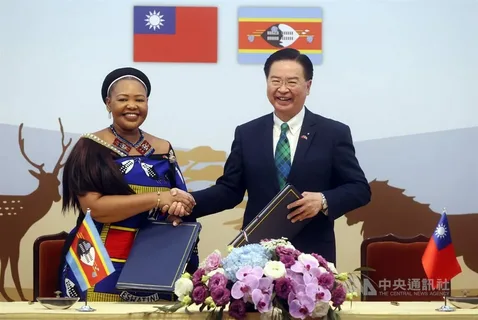
During a bilateral meeting, President Lai and King Mswati III both mentioned the 58th anniversary of diplomatic relations between their two countries. The two leaders also witnessed the signing of an agreement on mutual assistance in customs matters.
Following the trip drama, Eswatini’s Deputy Prime Minister Thuli Dladla swiftly visited Taiwan on April 30, underscoring that the Eswatini South Africa-style regional pressure was not enough to break the bond.
Quotes: Strong Words From Both Sides
President Lai told Eswatini’s King Mswati III: “The Republic of China, Taiwan, is a sovereign nation,” adding that 23 million Taiwanese have the right to engage globally and no country can stop them.
Taiwan’s Mainland Affairs Council dismissed Beijing’s rhetoric as “fishwife’s gutter talk,” insisting no permission was required from Beijing for such travels.
Beijing responded harshly. A spokesperson for China’s Ministry of Foreign Affairs said Lai’s visit would always be a losing cause and that nothing would ever change the fact that Taiwan is part of China. Beijing urged Eswatini to stop serving as a prop for Taiwan independence separatists.
China’s Taiwan Affairs Office described the visit as a stowaway-style escape farce, while officials in Beijing warned Eswatini not to pull chestnuts out of the fire for Taiwan independence separatists.
Eswatini China Relations: The Pressure Beijing Applies
The Eswatini China relations story is one of relentless coercion. Beijing declared “No diplomatic relations, no business benefits” and tightened visa restrictions on Swazis to pressure Eswatini into switching recognition. Eswatini has consistently rejected these overtures.
Eswatini is the only African nation without tariff-free access to China’s market due to its ties with Taiwan. This is a significant economic cost for a small country with a population of around 1.2 million people.
Despite this, the Eswatini South Africa relationship gives Mbabane a degree of economic cushion, as South Africa remains Eswatini’s dominant trade partner and the country it is landlocked within. However, South Africa Taiwan tensions remain low, as Pretoria itself recognized Beijing long ago and maintains no formal ties with Taipei.
Impact: What This Means Globally
Coinciding with Lai’s trip, China sent 21 military aircraft across the median line in the Taiwan Strait on May 3, according to Taiwan’s Ministry of National Defense, with ten naval vessels also detected near the island. The timing was seen as a deliberate warning.
On the eve of the visit, Chinese Foreign Minister Wang Yi told U.S. Secretary of State Marco Rubio in a phone call that Taiwan is the biggest risk when it comes to relations between Beijing and Washington.
The Eswatini Taiwan relations episode demonstrates how a landlocked kingdom with an Eswatini population of just 1.2 million has become a symbolic frontline in one of the world’s most consequential diplomatic battles. Taiwan South Africa relations remain non-existent at the formal level, but South Africa Taiwan tensions could grow if Beijing pushes Pretoria to exert regional influence on Eswatini.
Also in the News: Hinglaj Mata Temple
The Hinglaj Mata Temple, recently seen in news, is located in Balochistan, Pakistan specifically in the Lasbela district, inside Hingol National Park on the Makran coast.
The temple is one of the 51 Shakta pithas in Shaktism denomination of Hinduism, situated in a mountain cavern along the banks of the Hingol River.
The annual Hinglaj Yatra attracts an estimated 300,000 pilgrims over three days, making it the largest Hindu pilgrimage in Pakistan.
The Balochistan government has allocated special development funds in the 2025 budget for the temple’s restoration and to accommodate its growing number of visitors, with planned improvements including upgraded infrastructure and enhanced facilities for pilgrims.
Conclusion: A Friendship That Won’t Break
The Eswatini Taiwan relations story is far from over. Taiwan’s Minister of Foreign Affairs Lin Chia-lung arrived in Eswatini five days after the original trip’s cancellation, declaring that Taiwan would not be held back by authoritarian forces.
Taiwan’s formal allies are not decorative relics they remain part of Taipei’s argument that it enters international relations on its own terms and not as a subordinate of the People’s Republic of China.
As China’s global diplomatic campaign intensifies, Eswatini’s small population and economic vulnerability make its continued loyalty all the more remarkable and its relationship with Taiwan all the more significant for the international order.
FAQs
Does Eswatini still recognize Taiwan?
Yes. Eswatini is the only country on the African continent that still recognizes Taiwan, and it remains one of just 12 states globally that maintain formal diplomatic ties with Taipei.
What happened to Chen Shui-bian?
Chen Shui-bian was Taiwan’s president from 2000 to 2008. After leaving office, he was convicted of corruption and money laundering and sentenced to prison. He was later released on medical parole in 2015 due to deteriorating health and has remained in Taiwan. He is not directly related to the current Eswatini Taiwan relations situation, which involves President Lai Ching-te.
What is the relationship between Eswatini and China?
The government of Eswatini has rejected China’s overtures to switch diplomatic recognition. In response, China has tightened visa restrictions on Swazis and cut Eswatini off from tariff-free market access, with Beijing declaring “No diplomatic relations, no business benefits.” Despite this pressure, Eswatini has maintained its alliance with Taiwan.