America has been here before — but never quite like this. The cycle of US political violence that historians trace through the 1850s, the 1960s, and the 1970s has returned. But in 2025 and 2026, it is moving faster, hitting harder, and spreading wider than at any point in living memory.
The numbers are unambiguous. The targets are real. And the cycle shows no signs of slowing down.
The White House Correspondents’ Dinner Attack — April 25, 2026
The most recent flashpoint in the rise of political violence in the United States came at one of Washington’s most iconic annual events. A gunman stormed the Washington Hilton on April 25, 2026, during the White House Correspondents’ Association dinner — the third time in three years that Trump has come under threat from an attacker. The dinner was cancelled and the president addressed reporters from the White House afterwards. The incident sent shockwaves through a political class already living under extraordinary security pressure — and added another chapter to what researchers are calling the most dangerous period for US political violence since the turbulent years of the Vietnam War era.
The Numbers — Fastest Rise in Fifty Years
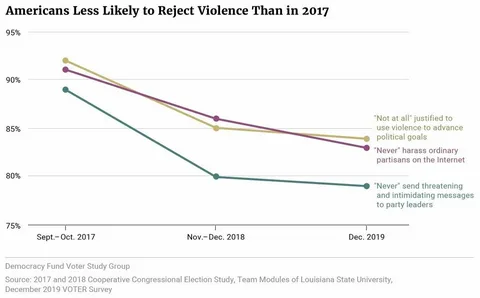
The data behind the rise of political violence in the United States is striking. In the first half of 2025 alone, more than 520 incidents of terrorism and targeted violence occurred — roughly a 40% increase compared to the first half of 2024. Targeted violence grew by more than 30% from all of 2024 to all of 2025, according to the National Consortium for the Study of Terrorism. Mass-casualty attacks — events where four or more people were killed or wounded — rose by a staggering 187.5% in the first six months of 2025 compared to the same period in 2024. Researchers now describe US political violence as being at its highest level since the 1970s — not a fringe concern, but a mainstream political reality.
High-Profile Assassinations — A Country in Shock
The list of recent political violence in the United States reads like a horror roll. In June 2025, Minnesota House Speaker Melissa Hortman and her husband were fatally shot in their home — what the Department of Justice described as “heinous political assassinations.” In September 2025, conservative activist and political commentator Charlie Kirk was assassinated during a public event at Utah Valley University in Orem, Utah. The Capitol Police reported a 58% rise in threats against members of Congress in 2025 alone. Researchers at the University of Maryland documented 150 politically motivated attacks in the first half of 2025 — nearly double the figure from the same period the previous year. The history of political violence in the United States has few precedents for this pace of escalation.
Who Is Behind the Violence — A Shifting Picture
One of the most significant findings in recent US political violence research concerns which side is driving the current surge. For most of modern American history, right-wing extremists accounted for the majority of domestic political attacks. That changed in 2025. For the first time in more than 30 years, left-wing attacks outnumbered those from the violent far right, according to data compiled by the Center for Strategic and International Studies. However, researchers emphasise the important context — left-wing violence rose from historically low levels, and right-wing extremism remains capable of rapid remobilisation. The Anti-Defamation League documented that all 61 political killings between 2022 and 2024 were committed by right-wing extremists. The political violence poll data shows the problem is genuinely cross-ideological.
The Role of Rhetoric — Pouring Fuel on the Fire
The rise of political violence in the United States cannot be separated from the political rhetoric that surrounds it. In November 2025, Trump made multiple social media posts calling Democrats traitors who should be charged with sedition “punishable by death” — and shared a post calling for Democrats to be hanged. House Oversight Chair James Comer acknowledged the president’s role: “Trump probably pours fuel on that fire.” A May 2025 Chicago Project on Security and Threats survey found that around 40% of Democrats supported the use of force to remove Trump from the presidency, while 25% of Republicans supported using the military to stop protests against Trump’s agenda. Those numbers more than doubled since autumn 2024. US political violence is increasingly normalised in the language of both parties — even if the vast majority of Americans still oppose it in practice.
The History of Political Violence — This Pattern Has Appeared Before
The history of political violence in the United States shows this is not unprecedented — but it is unusually dangerous. Political scientist James Piazza of Penn State draws a direct comparison to the 1850s, when sharp divisions over slavery produced political assassinations, Congressional assaults, and armed conflict in Kansas. The early 1900s brought another wave, driven by labour disputes and Ku Klux Klan resurgence. The late 1960s and early 1970s saw political assassinations, bombings, and widespread civil unrest. What distinguishes today’s US political violence from those earlier periods, researchers say, is the absence of a specific grievance that could be addressed through policy. The current polarisation is more diffuse — it is not about one issue but about identity, legitimacy, and existential threat. That makes it harder to resolve.
Where Is It Going — 2026 and Beyond
The political violence poll conducted by the Chicago Project on Security and Threats found that 70% of Americans still oppose political violence in all forms — a figure that provides some reassurance. But the fringes present genuine and growing risks. The Bridging Divides Initiative at Princeton warns that aggressive federal deployments, Trump administration consideration of the Insurrection Act, and an approaching midterm election season will create further flashpoints throughout 2026. Researchers describe the current dynamic as a self-reinforcing spiral — each act of US political violence triggers a spike in threats, which triggers security crackdowns, which produce new grievances, which generate new attacks. Without significant de-escalation from political leaders on both sides, that cycle — now in overdrive — shows no sign of breaking.
Frequently Asked Questions
Is political violence increasing in the USA?
Yes, significantly. US political violence is at its highest level since the 1970s. More than 520 incidents of terrorism and targeted violence occurred in the first half of 2025 alone — a 40% increase year on year. Mass-casualty attacks rose 187.5% in the same period. High-profile assassinations in 2025 included Minnesota House Speaker Melissa Hortman and conservative commentator Charlie Kirk, and 2026 opened with federal agents fatally shooting civilians in Minnesota and a gunman attacking the White House Correspondents’ Dinner on April 25.
What is driving the rise of political violence in the United States?
Researchers identify several converging factors behind the rise of political violence in the United States: extreme political polarisation that has created a zero-sum environment where every election feels existential; dehumanising rhetoric from political leaders that normalises threats and violence; online radicalisation through social media where extremist content spreads rapidly; the pardoning of January 6 participants, which experts say created a perceived “permission structure” for further violence; and economic anxiety and cultural displacement that make individuals susceptible to violent ideologies. The current environment lacks a single unifying issue that could serve as a focus for resolution.
What are the categories of violence in the US?
Researchers studying US political violence typically divide incidents into three main ideological categories: right-wing extremist violence, which historically accounts for the majority of domestic political killings and includes white nationalist, anti-government, and militia-driven attacks; left-wing extremist violence, which rose significantly in 2025 to outnumber right-wing incidents for the first time in 30 years, driven largely by anti-Trump and anti-government activism; and Islamist-motivated terrorism, which has declined significantly since its peak in the 2000s and 2010s. A fourth growing category is unaffiliated or lone-actor violence — individuals who self-radicalise through internet content without belonging to any formal organisatio