Pakistan is in a critical race against time to fulfill its commitments under the Sustainable Development Goals Pakistan 2030 framework. As of late 2025, Pakistan’s progress on the United Nations Sustainable Development Goals remains off-track, with the country ranking 140th in the Sustainable Development Report 2025, reflecting persistent challenges in the final stretch toward the 2030 Agenda.With just a few years left, the gap between targets and achievements is a growing national concern.
Background: What Are the Sustainable Development Goals?
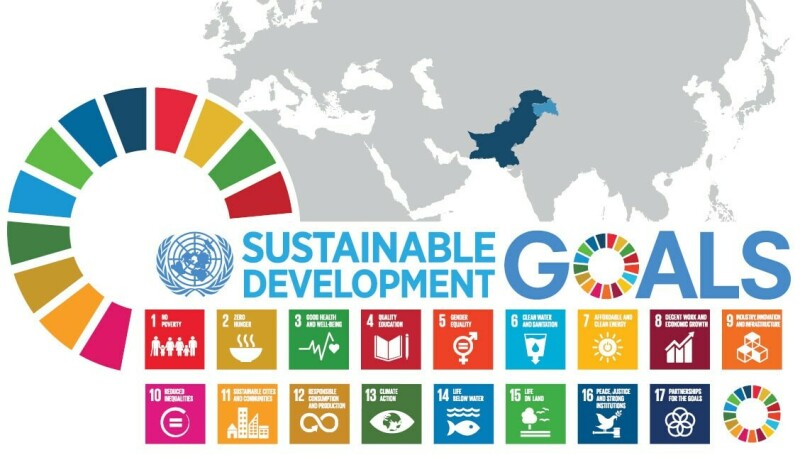
The Sustainable Development Goals (SDGs) are a set of 17 global goals adopted by the United Nations in 2015. The SDGs, also known as the Global Goals, were adopted by the United Nations in 2015 as a universal call to action to end poverty, protect the planet, and ensure that by 2030 all people enjoy peace and prosperity
The 17 SDGs are integrated they recognize that action in one area will affect outcomes in others, and that development must balance social, economic and environmental sustainability.These goals cover everything from zero hunger and quality education to climate action and gender equality.
For Pakistan specifically, the sustainable development Pakistan project began with a historic parliamentary milestone. Pakistan was the first country to adopt the SDGs 2030 agenda through a unanimous resolution of parliament.This early commitment set the tone for what would become a decades-long national development journey.
Pakistan’s Institutional Framework for SDGs
Understanding sustainable development in Pakistan requires looking at how the country built its governance structures. Soon after the adoption of the 2030 Agenda for Sustainable Development by the UN General Assembly in September 2015, the Government of Pakistan started the localization of SDGs by establishing dedicated SDG Support Units within Planning Institutions at the federal and provincial level.
In February 2016, the National Assembly of Pakistan passed a unanimous resolution declaring SDGs as the country’s National Development Goals. The SDG Support Units help create an enabling environment for the implementation of the 2030 Agenda.
The Federal SDG Unit in collaboration with the Planning Commission and UNDP developed the National SDG Framework a guiding document that establishes SDG targets for Pakistan to achieve by 2030. The National SDG Framework has been approved by the National Economic Council, chaired by the Prime Minister.
Pakistan’s Vision 2025 played a central role in aligning national planning with global goals. The seven pillars of Vision 2025 are fully aligned with the SDGs, providing a comprehensive long-term strategy for achieving inclusive growth and sustainable development.
Sustainable Development Pakistan 2021: Where Did Things Stand?
The sustainable development Pakistan 2021 report marked a critical checkpoint. Pakistan’s SDGs status report for 2021, the first of its kind, was published by the Federal SDGs Support Unit at the Ministry of Planning, Development, and Special Initiatives. According to the report, Pakistan ranked 129th out of 165 countries in 2021.
The 2021 report brought both small victories and hard truths. The report highlights that Pakistan’s progress on SDG 1 (No Poverty) was somewhat steady, with approximately 9.3 million people lifted out of poverty based on the national poverty line.However, this progress did not last.
Poverty increased by 7 percent in Pakistan in 2024, with an additional 13 million people falling into poverty.This reversal is one of the clearest signs that sustainable development in Pakistan faces deep structural challenges that cannot be solved through policy alone.
Details: The 2025 Policy Dialogue and New Momentum
In a significant development, Pakistan and its international partners stepped up pressure in 2025. In May 2025, the Government of Pakistan and UNDP convened the ‘Pakistan SDGs Policy Dialogue for Action: Accelerating Reform, Investments, and Economic Transformation Toward Agenda 2030,’ held under the Government of Pakistan-UNDP supported SDGs Plus Program 2024-2030.
The event was a high-level gathering that brought together lawmakers, ministers, UN agencies, and the IMF. The Dialogue engaged national and provincial parliamentarians, senior government officials, development partners, UN agencies, as well as the IMF, to discuss Pakistan’s progress toward achieving the SDGs, efforts to set new data baselines, strengthen institutional coordination, mobilize climate and development financing, and enhance accountability through parliamentary oversight and digital tools.
The financing gap emerged as one of the starkest findings. According to UNDP’s Integrated SDG Insights Report, Pakistan is on track to meet only 35 out of 169 SDG targets. To achieve Agenda 2030, Pakistan needs a substantial ‘SDG Push’ that involves high-intensity economic reforms and an additional 16.1 percent of GDP.
Quotes: Government and Expert Voices
Key officials did not shy away from acknowledging how much work remains.
Federal Minister for Planning Ahsan Iqbal stated: “Let us make today a turning point. Let this dialogue and its report be the beginning of a renewed compact between state and society. Let us reclaim development as a collective mission where no one is invisible, and no dream is too ambitious.”
Minister of Climate Change Dr. Musadik Malik reflected: “The stark disparities faced by the people of Pakistan whether maternal mortality, out-of-school children, or access to clean drinking water demand urgent action to go beyond despondence and build resilience. We must move beyond processes and focus on delivering tangible outcomes that improve lives and restore dignity to our most vulnerable citizens.”
UNDP Pakistan Deputy Resident Representative Ms. Van Nguyen added: “Parliamentary committees and taskforces can ensure that annual budgets are aligned with SDG priorities, that project feasibilities reflect the true cost of climate resilience, and that laws enacted at the center do not contradict ambitions at the periphery.”
Key Challenges Facing Sustainable Development in Pakistan
The sustainable development Pakistan essay whether academic or journalistic cannot ignore the scale of obstacles the country faces.
Pakistan is on track for only about 35% of targets, with eight SDGs stagnating and three regressing, particularly in zero hunger, gender equality, climate action, and life on land. High debt, political instability, climate vulnerabilities, data gaps, and a massive annual financing shortfall of around $60 billion hinder progress.
Pakistan’s limited engagement in global partnerships and reliance on foreign aid without fostering self-sustaining collaborations restrict the exchange of knowledge and resources necessary for achieving the SDGs. Governance and corruption issues, including a weak rule of law and financial corruption, further undermine efforts to ensure transparency and justice in SDG implementation.
On hunger specifically, the situation is alarming. According to the Global Hunger Index, Pakistan ranked 109th out of 127 countries, with a score of 27.9, indicating a serious level of hunger. Approximately 20.7% of Pakistan’s population is undernourished.
Education and the SDG 4 Push in 2025
One of the most concrete sustainable development Pakistan projects in recent years has been the push on SDG 4 Quality Education. In February 2025, the Federal Education Ministry, along with UNESCO and the Pakistan Institute of Education, launched the SDG-4 Midterm Review Report, which introduced policy reforms, increased investment, and data-driven approaches that would reduce regional education disparities and accelerate progress toward SDG 4 by 2030.
In May 2025, Pakistan and UNDP co-hosted the Pakistan SDGs Policy Dialogue for Action, aligning with the Uraan Pakistan economic transformation plan a roadmap to sustainable growth. This dialogue focused on enhancing institutional coordination, data governance, financing, and parliamentary oversight to fast-track SDGs progress.
Impact: What This Means for Pakistan and the Region
The stakes of sustainable development Pakistan 2030 go beyond numbers on an index. Millions of lives in health, education, food security, and climate resilience depend on how seriously and effectively the country pursues these goals.
With less than five years left, Pakistan must accelerate progress across all 17 SDGs in the face of fiscal stress, climate shocks, and social inequalities.Pakistan is also one of the world’s most climate-vulnerable nations, making SDGs linked to the environment especially urgent.
Achievements in recent years include macroeconomic stabilization in 2024-2025, with inflation at a six-year low, expanded electricity access, and modest gains in health indicators like reduced maternal mortality. Digital transformation and partnerships also show promise in areas like decent work and infrastructure.
Conclusion: Can Pakistan Meet the 2030 Deadline?
The Sustainable Development Goals Pakistan 2030 agenda is ambitious and so are the challenges. Pakistan has built institutions, passed resolutions, and hosted high-level dialogues. But as the 2030 deadline approaches, converting policy into tangible outcomes is more urgent than ever.
From financing strategies and subnational visions to women’s leadership, decentralization, and innovation, Pakistan must capture the urgency and ambition needed to finish the SDG race strong.
The path forward demands not just government action but also civil society, the private sector, international partners, and every citizen playing a role. The next few years will define whether the sustainable development Pakistan story is one of missed opportunity or historic achievement.
FAQs
What is sustainable development in Pakistan?
Sustainable development in Pakistan refers to the country’s national strategy to achieve economic growth, social inclusion, and environmental protection simultaneously. Pakistan affirmed its commitment to the 2030 Agenda for Sustainable Development by adopting the SDGs as its own national development agenda through a unanimous National Assembly Resolution in 2016. Since then, the country has made considerable progress by mainstreaming these goals in national policies and strategies and developing an institutional framework for SDGs implementation.
What are the 4 pillars of SDG?
While the UN officially organizes the SDGs around people, planet, prosperity, peace, and partnership (the “5 Ps”), many frameworks simplify them into four core pillars: social development, economic development, environmental sustainability, and good governance. The 17 SDGs are integrated they recognize that action in one area will affect outcomes in others, and that development must balance social, economic, and environmental sustainability.
What are the 7 pillars of sustainability?
The 7 pillars of sustainability commonly referenced in development literature are: economic sustainability, social sustainability, environmental sustainability, cultural sustainability, political sustainability, technological sustainability, and institutional sustainability. In the Pakistan context, the seven pillars of Vision 2025 are fully aligned with the SDGs, providing a comprehensive long-term strategy for achieving inclusive growth and sustainable development. These pillars range from human development to infrastructure, energy, and governance reform.