
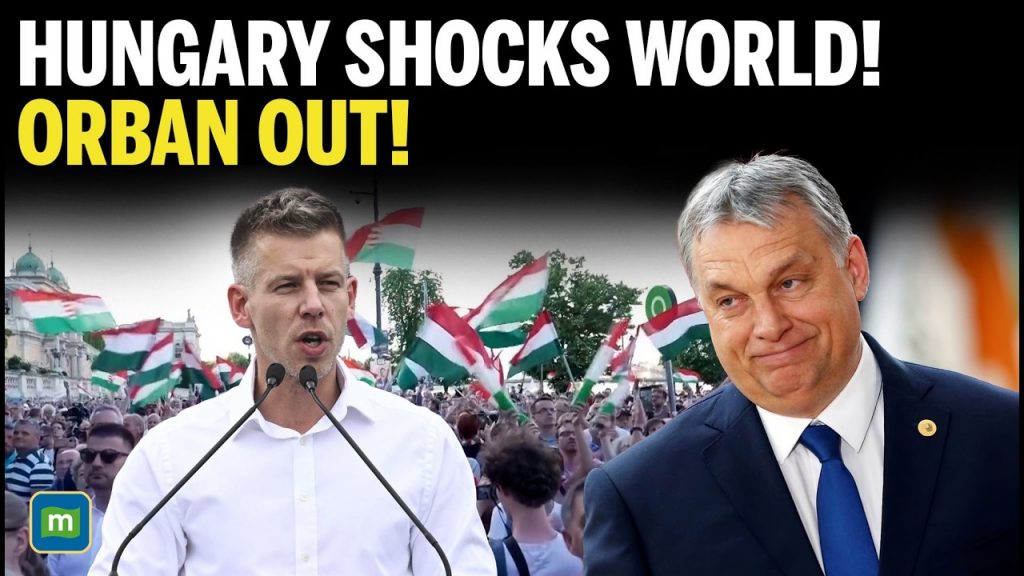

Hungarian Prime Minister Viktor Orbán has conceded defeat in the country’s parliamentary election after partial official results showed Péter Magyar’s Tisza party winning by a landslide. With 97.35 percent of precincts counted, Magyar’s centre-right party secured 138 seats in the 199-seat parliament on 53.6 percent of the vote, while Orbán’s Fidesz took just 55 seats with 37.8 percent.
Election officials estimated turnout at a record of 79 percent or more, in an election that many Hungarians saw as a watershed moment for their country.The result marks the end of one of Europe’s most dominant political careers of the 21st century.
Orbán served as Prime Minister of Hungary from 1998 to 2002 and again from 2010 until 2026. His government promoted Christian nationalism. During his rule, Hungary underwent major constitutional, political, and institutional changes that led many observers to describe it as a hybrid regime, or illiberal democracy, that blends democracy with authoritarianism.
In a 2014 speech, Orbán himself described Hungary under his rule as an “illiberal state.” Initially a liberal during the 1990s and early 2000s, he eventually evolved his politics closer to the radical right and the far-right, being widely considered one of the leaders of the global far-right.
Hungary remained a full member of both the EU and NATO throughout Orbán’s rule, even as his government clashed repeatedly with Brussels over democratic standards, press freedom, and minority rights.
Details
Who Is Péter Magyar?
The winner of Sunday’s elections, Péter Magyar, head of the Tisza party, is Orbán’s former ally who displays much the same set of political values, especially when it comes to the issue of immigration and even geopolitics.
Former government insider Magyar, 45, burst onto the scene just two years ago, amassing support against the backdrop of economic stagnation, despite an electoral system skewed in favour of Fidesz.His rapid rise shocked political analysts who had long assumed Orbán’s grip on power was unbreakable.
Viktor Orbán Approval Rating Collapses
When respondents were asked who they believed was most suitable to serve as Hungary’s prime minister ahead of the vote, 48.7 percent chose Magyar, while Orbán was selected by only 40.8 percent. The poll was conducted between April 5 and April 10, 2026, with 1,587 respondents.
Results closely tracked independent polling showing Tisza with a clear lead, while pro-government pollsters projected a Fidesz win.The deep split between government-aligned and independent pollsters had been a defining feature of the pre-election period.
Hungary Economy Under Orbán
A key driver of Orbán’s declining support was economic frustration. Many Hungarians had grown increasingly weary of Orbán after three years of economic stagnation and soaring living costs, as well as reports of oligarchs close to the government amassing more wealth.
For younger voters especially, the economic picture was grim. A 24-year-old named Kriszta told Reuters: “I know that my future depends on this,” adding that she planned to leave Hungary if Orbán won.The brain drain fear was a recurring theme throughout the campaign.
Russian Interference Allegations
The campaign was also shadowed by serious allegations. Orbán’s campaign was shaken by media reports alleging his government colluded with Moscow on diplomatic and political matters.
On March 21, 2026, The Washington Post reported that Russia’s Foreign Intelligence Service proposed staging a false flag assassination attempt on Orbán in an attempt to improve his election odds, according to an internal report obtained by a European intelligence service.Orbán denied all wrongdoing.
Trump, Vance, and the Global Right
Orbán had long positioned himself as a hero of the global right wing. United States Vice President JD Vance visited Budapest earlier in election week to rally with Orbán, saying that Trump had promised to bring US economic might to Hungary if Fidesz secured victory.
Magyar’s victory has been widely described as a victory for the EU and a loss for Russia, the Trump administration, and the global far-right.It signals a possible reversal in the international tide of right-wing populism.
Quotes
In a victory speech to tens of thousands of supporters gathered along the Danube River in Budapest, Magyar declared: “Tonight, truth prevailed over lies. Today, we won because Hungarians didn’t ask what their homeland could do for them; they asked what they could do for their homeland.”
Orbán, speaking at Fidesz campaign offices, said: “The election result is painful for us, but clear.”Some of his supporters wept as they watched him speak on television screens.
European Commission President Ursula von der Leyen declared: “Europe’s heart is beating stronger in Hungary tonight. Hungary has chosen Europe. Europe has always chosen Hungary.”Former US President Barack Obama hailed the result, writing: “The victory of the opposition in Hungary, like the Polish election in 2023, is a victory for democracy, not just in Europe but around the world.”
Impact
Is Hungary in the EU and What Does This Mean for Brussels?
Yes, Hungary is and has remained a member of the European Union. However, under Orbán, it became the bloc’s most rebellious member, frequently vetoing EU decisions and clashing with Brussels over rule-of-law standards.
Orbán’s defeat will likely spell an end to Hungary’s adversarial role inside the EU, possibly opening the way for a 90 billion euro loan to war-battered Ukraine, which had been blocked by Orbán.
Like the majority of Hungarians, Magyar is a Ukraine-sceptic who doesn’t want his country to aid Kyiv financially or militarily, even though his government is expected to unblock the EU’s 90 billion euro loan to Ukraine, crucial for sustaining the war with Russia.
Is Hungary a Democracy?
The question of whether Hungary remained a true democracy under Orbán was fiercely debated for years. Many observers described Hungary under Orbán as a hybrid regime that blends democracy with authoritarianism and moved away from the rule of law.
For all the talk of Orbán being an authoritarian or even a dictator, he quickly conceded defeat in a tearful speech to his supporters a moment that itself underlined that Hungary’s democratic institutions had survived, even if severely strained.
Is Hungary in NATO?
Hungary is a NATO member and has been since 1999. It was actually Orbán’s first government that brought Hungary into NATO in 1999 and that successfully conducted the negotiations on Hungary’s accession to the EU.Under Magyar, Hungary is expected to return to a more cooperative stance within both alliances.
Orbanism Lives On in Europe
Analysts warn that removing Orbán does not remove Orbánism. Slovakia is now ruled by Prime Minister Robert Fico, who aligned with Orbán on most issues, especially when it came to Ukraine. In Czechia, a Ukraine-sceptic coalition under Prime Minister Andrej Babis is now in charge. In Poland, the Ukraine-sceptic President Karol Nawrocki has been clashing with the pro-Ukrainian government of Prime Minister Donald Tusk.
The EU’s broader political shift to the right did not begin and will not end with Orbán alone.
Conclusion
Hungary’s 2026 election is a historic turning point. Magyar said the results represented a historic mandate and pledged to unite all Hungarians, declaring: “In the history of democratic Hungary, this many people have never voted before, and no single party has ever received such a strong mandate as Tisza.”
The new government faces enormous challenges: a fragile economy, an electoral system built to favour Fidesz, and deep social divisions. Orbán’s political career might be dead-ended, but Orbánism is very much alive and kicking both inside Hungary and across Europe’s shifting political landscape. The world will be watching closely to see whether Magyar can deliver on his promise of a new, democratic Hungary rooted firmly in its European identity.
FAQs
Is Viktor Orbán right wing?
Yes. Viktor Orbán is widely considered a right-wing, nationalist politician. Over his years in power, he moved from liberal conservatism toward the far right, embracing Christian nationalism, anti-immigration policies, and close ties with leaders like Donald Trump and Vladimir Putin. He is often described as one of the founding figures of modern right-wing populism in Europe.
Why are people becoming more right-wing?
Political analysts point to several factors driving the right-wing shift in many democracies: economic insecurity and inflation, anxiety over immigration and cultural change, distrust of mainstream institutions and media, and a sense that traditional liberal parties have failed to deliver. Right-wing leaders often offer simple, identity-based answers to complex problems, which appeals to voters who feel left behind.
What are the 5 main purposes of the European Union?
The EU was built around five core goals: (1) promoting peace and stability among member states, (2) creating a single market with the free movement of goods, services, capital, and people, (3) upholding democracy and the rule of law across member countries, (4) representing Europe collectively in global trade and diplomacy, and (5) supporting economic development and reducing inequality between richer and poorer member states.